Military shouldn’t investigate sexual assaults in Canadian Forces, say experts
A Canadian Forces review into sexual assaults in the military may not be enough to tackle the problem if a cultural shift and the way those crimes are investigated and prosecuted aren’t also addressed, experts say.
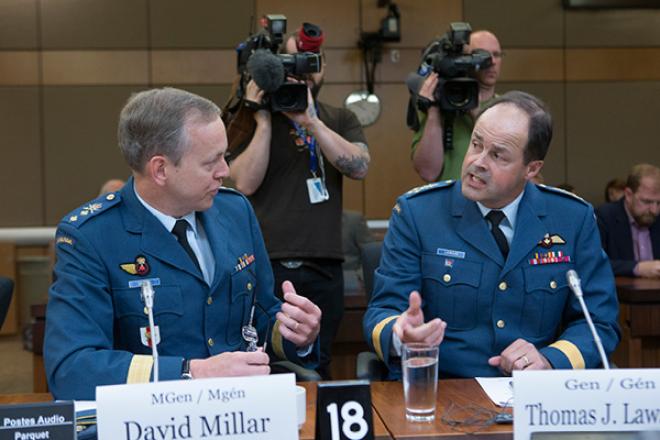
Gen. Tom Lawson, Canada’s chief of defence staff, told members of the House National Defence Committee last week that the Forces would undertake an external review to examine sexual assaults. The committee held a meeting on the subject after an April report published in L’actualité and Maclean’s magazines that said sexual abuse was rampant in the Forces.
The external review will begin in the next month or two and follows an internal review launched in responce to the magazine articles.
Gen. Lawson said the internal review revealed “systemic barriers” that keep victims from coming forward.
The Canadian Forces have put out the terms of reference for the external review and passed it on to Defence Minister Rob Nicholson (Niagara Falls, Ont.) and are now looking for a “distinguished Canadian” with a judicial background to lead it, Gen. Lawson said.
“What we need to do is we have to take steps to ease the process for those who feel victimized to come forward—make sure they’re protected, looked after,” he told reporters outside the committee room.
The magazine articles said military police get up to 200 sexual assault complaints every year and that many more go unreported for fear of consequences from the military hierarchy.
The Canadian Forces also have to make sure there’s “standardization” in how commanding officers and those who investigate and prosecute sexual assaults respond to allegations, Gen. Lawson said.
But critics, including MPs who expressed dismay at the reports of abuse during the testimony, aren’t convinced the external review will get to the root of the problem.
Ian Bron, a former Canadian Navy officer who was a victim of abuse in the 1980s, said the investigation and prosecution of sexual assaults need to be removed from the military.
“The amount of influence that both the military police and the military lawyers have is quite extraordinary. They’re not just representing the victim, they’re representing the military,” said Mr. Bron, now a director at whistleblower organization Canadians for Accountability, in an interview.
“So if they have a senior officer that doesn’t really want a particular case to come out, it’s going to take a great deal of individual moral courage and strength to resist that. The best thing to do is just to take most of that process out of their hands. That just removes any conflict-of-interest that might exist,” said Mr. Bron.
Victims of assault would be more comfortable speaking to police outside the military who share broader society’s views on sexual abuse, he said. The last thing they want is to tell their story to someone they suspect knows the assailant, which is likely given connections within the close-knit military community. Military police investigate certain offences very effectively but sexual assault has not been handled well, Mr. Bron said.
Michel Drapeau, a retired colonel and military law expert, also said sexual assaults should be handled in civilian courts.
“This is not a military offence,” he said in an interview. “If murders and homicides and kidnapping of children can be tried by a civilian court, and that’s what the law now says, it can also say so for sexual assault.”
Prosecution of sexual assaults was moved to the military in 1998, “slipped in” as part of massive changes to the National Defence Act in the wake of the inquiry into abuse by Canadian soldiers in Somalia, Mr. Drapeau said. He said he couldn’t find the rationale for the change.
Maj.-Gen. Blaise Cathcart, the judge advocate general who also testified at the hearing last week, said Parliament gave jurisdiction over sexual assault to the military for two reasons.
“One is because they recognized that sexual assault, like all offences, go to the heart of discipline in the Canadian Armed Forces. Especially when members assault members, there can’t be a more critical moment in time to have military justice come to the fore,” he told reporters after the hearing.
“And the second piece is to make sure that those cases are dealt with in a proper context.”
Mr. Drapeau said there’s no need for an external review, especially one whose members are picked by the Department of National Defence. While he doesn’t think there’s widespread tolerance for sexual assault at the department, the approach to dealing with offences is lacking, he said.