
PUBLISHED : Wednesday, June 29, 2016 12:00 AM
The Liberals’ decision to lift the visa requirement on Mexico starting Dec. 1 has drawn opposition from Conservatives who say the move sets a dangerous precedent and threatens the credibility of Canada’s immigration system.
Opposition immigration critic Michelle Rempel (Calgary Nose Hill, Alta.) told The Hill Times that the decision of Prime Minister Justin Trudeau (Papineau, Que.) to lift the visa requirement on Mexico Tuesday was “short-sighted” and used “backwards logic.” The MP said the decision demonstrates preferential treatment being given to one country over others when it comes to visa restrictions.
At the front of the line of countries pressuring Canada to lift visa restrictions are Bulgaria and Romania, the only two European Union countries still subject to Canadian visa restrictions. They’ve been pushing Canada hard to lift the visa for years, going as far as threatening the implementation of the CETA Canada-EU free trade deal. The EU is also in the midst of deciding whether the bloc should slap retaliatory visas on Canadians.
If the Canadian government decided to let Mexico bypass the normal visa-lifting criteria, then it should do the same for Romania, Bulgaria, and other countries pushing to lift Canadian visas, the argument goes. Ms. Rempel isn’t the only one who thinks Canada’s decision to lift visa restrictions for Mexico could have implications elsewhere.
“I think that we cannot have a double standard,” EU Ambassador Marie-Anne Coninsx, told Embassy in January. Ms. Coninsx was unavailable for further comment at the time of Mr. Trudeau and Mr. Peña Nieto’s announcement. At the time, she was referring to the campaign promise that Mr. Trudeau had made to lift the visa requirement on Mexico.
If the Mexicans met all the Canadian conditions for visa-free travel, she said, there’s no problem.
“But in case, for example that in the case of Mexico that it will be a political decision to lift the visa, and it will be not a political decision for Romania, I think this will be difficult for us,” Ms. Coninsx said.
“What are you going to tell the Romanians and the Bulgarians and other countries that are listening to this?” said Ms. Rempel. “I think the problem is the Liberals have now sort of painted themselves into a corner [with this] political decision.”
She said her party’s position is that it is “laudable” for the government to want to increase mobility with significant trading partners like Mexico, “but there’s a lot of issues the Mexican government has to deal with. And they haven’t shown that they’ve done that.”
“We as Canadians want to be positive partners and collaborate and help address some of the very real issues facing our friends and neighbours around the world and particularly Mexico in this case.”
Bulgarian Ambassador Nikolay Milkov wrote in an email to The Hill Times that Canada “indeed made a political commitment to lift the visa regime for citizens of Mexico,” and that through this political decision, Mr. Trudeau separated Mexico from the issue of visas for Bulgaria and Romania.
“The issue of Mexico is important to the [extent] this country complies to the formal requirements for visa free travel to Canada,” wrote Mr. Milkov, saying that was up to Citizenship and Immigration Canada to decide.
“Once you know the degree of compliance of Mexico to these criteria you may have your conclusion about the integrity of the standards of evaluation and about the nature of the decision proclaimed today. We hope there are not different standards for the countries under assessment because we believe that Canada is a reliable partner in our efforts to solve this irritant in the relations with the EU, and with Bulgaria and Romania on a bilateral basis,” he said.
Mr. Trudeau promised in his election platform last fall to lift the visa on all Mexicans “immediately.” But public servants in the federal immigration department have said in the days leading up to Mexican President Enrique Peña Nieto’s state visit to Canada that Mexico does not meet all the visa-lifting criteria.
Ms. Rempel, who has raised her concerns on several occasions in the House as well as in committee meetings discussing the matter, said “you could see the discomfort with department officials at committee” as they defended the fact that the standard formal review of a country to determine whether or not it meets Canada’s criteria for visa-free travel, was not done.
“Reports state that Canada will only lift the visa if Mexico ‘offers assurances there won’t be a flood of people from Mexico claiming refugee status.’ Are the Liberals making serious policy decisions on the basis of pinky promises? Canada has responsibility for our own visa policies, based on our own interests. A country that takes its sovereignty seriously does not outsource or negotiate away these responsibilities,” she said in a statement last week.
Currently, citizens from Mexico and another 148 countries must get a visa before they’re allowed into Canada, including Brazil, China, India, and Russia. Several countries, including Ukraine and Romania, have complained about Canada’s onerous process and pressed Canada to lift visas on their citizens.
Human rights groups are also protesting the government’s decision to tie the visa decision to refugee numbers.
Amnesty International brought four women to Parliament Hill last week to tell their stories and experiences of torture, disappeared family members, and the corruption of Mexican government officials and police they had witnessed. Amnesty International secretary general Alex Neve said the imposition of a visa requirement in the first place posed a challenge to Mexican refugees seeking asylum in Canada.
He also said the government’s reported plan to reinstate the visa if the number of asylum seekers grew too high was deeply concerning. The Globe and Mail reported last week that the Liberal government is prepared to partially reimpose the visa requirement if the number of Mexican asylum seekers surpasses 3,500 within any 12-month period.
He and the four Mexican activists accompanying him urged Mr. Trudeau to address what they described as a human rights crisis with Mr. Peña Nieto. At Tuesday’s announcement, Mr. Trudeau appeared to suggest he did.
He said he spoke with Mr. Peña Nieto about “the need to engage in constructive dialogue and ensure a strengthening of the rule of law” and added that “it is important that we move forward towards greater respect and defence of human rights, and that’s – that’s part of the things that friends work together on well.”
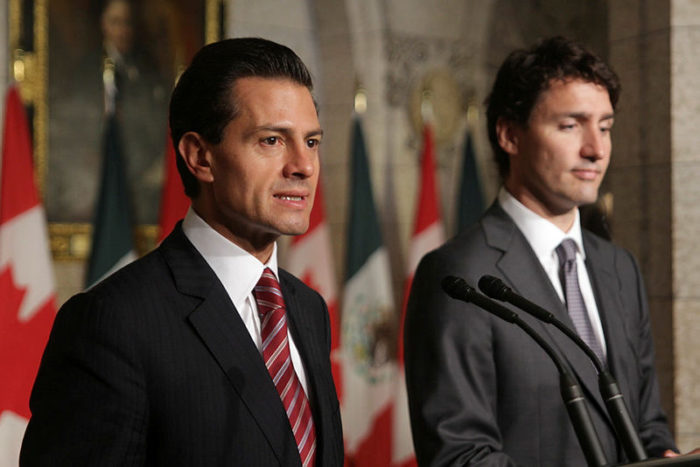
Mr. Peña Nieto and Mr. Trudeau announced that limits on Canadian beef exports to Mexico would be completely lifted. The pair also signed a memorandum of understanding that will “expand cooperation on indigenous issues,” said Mr. Trudeau.
Business and tourism groups have for years been pressuring the Liberals and Conservatives before them to lift the Mexican visas. They say the visas hurt business ties and the flow of Mexican tourists to Canada.
Ms. Rempel said that the possibility of first lifting the visa only to reimpose it shortly after would be bad news for the investors and lobby groups who will benefit from the lifting of a visa requirement on Mexico. The barrier would be lifted, the investments would flow, tourism would thrive, and then it would all come to a halt once again if it turns out the visa must be reinstated.
“It shows instability and short-sightedness,” said Ms. Rempel, adding that her own prediction is that the visa will have to be reinstated after only a short while.
cnash@hilltimes.com
@chels_nash
http://www.hilltimes.com/2016/06/29/visa-lifting-for-mexico-sets-bad-precedent/71787