
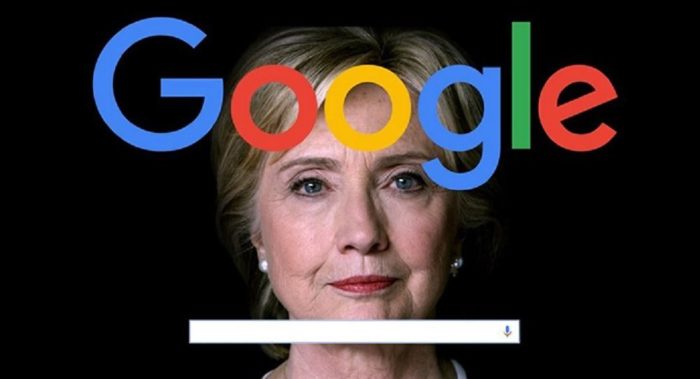
In this exclusive report, distinguished research psychologist Robert Epstein explains the new study and reviews evidence that Google’s search suggestions are biased in favor of Hillary Clinton. He estimates that biased search suggestions might be able to shift as many as 3 million votes in the upcoming presidential election in the US.
A scientific study I published last year showed that search rankings favoring one candidate can quickly convince undecided voters to vote for that candidate — as many as 80 percent of voters in some demographic groups. My latest research shows that a search engine could also shift votes and change opinions with another powerful tool: autocomplete.
In June of this year, Sourcefed released a video claiming that Google’s search suggestions — often called “autocomplete” suggestions — were biased in favor of Mrs. Clinton. The video quickly went viral: the full 7-minute version has now been viewed more than a million times on YouTube, and an abridged 3-minute version has been viewed more than 25 million times on Facebook. The video’s narrator, Matt Lieberman, showed screen print after screen print that appeared to demonstrate that searching for just about anything related to Mrs. Clinton generated positive suggestions only. This occurred even though Bing and Yahoo searches produced both positive and negative suggestions and even though Google Trends data showed that searches on Google that characterize Mrs. Clinton negatively are quite common — far more common in some cases than the search terms Google was suggesting. Lieberman also showed that autocomplete did offer negative suggestions for Bernie Sanders and Donald Trump.
Google responded to the Sourcefed video in an email to the Washington Times, denying everything. According to the company’s spokesperson, “Google Autocomplete does not favor any candidate or cause.” The company explained away the apparently damning findings by saying that “Our Autocomplete algorithm will not show a predicted query that is offensive or disparaging when displayed in conjunction with a person’s name.” Since then, my associates and I at the American Institute for Behavioral Research and Technology (AIBRT) — a nonprofit, nonpartisan organization based in the San Diego area — have been systematically investigating Lieberman’s claims. What we have learned has generally supported those claims, but we have also learned something new — something quite disturbing — about the power of Google’s search suggestions to alter what people search for. Lieberman insisted that Google’s search suggestions were biased, but he never explained why Google would introduce such bias. Our new research suggests why — and also why Google’s lists of search suggestions are typically much shorter than the lists Bing and Yahoo show us. Our investigation is ongoing, but here is what we have learned so far:
Google says its search bar is programmed to avoid suggesting searches that portray people in a negative light. As far as we can tell, this claim is false.
As for Google Trends, as Lieberman reported, Google indeed withholds negative search terms for Mrs. Clinton even when such terms show high popularity in Trends. We have also found that Google often suggests positive search terms for Mrs. Clinton even when such terms are nearly invisible in Trends. The widely held belief, reinforced by Google’s own documentation, that Google’s search suggestions are based on “what other people are searching for” seems to be untrue in many instances.
Google tries to explain away such findings by saying its search bar is programmed to avoid suggesting searches that portray people in a negative light. As far as we can tell, this claim is false; Google suppresses negative suggestions selectively, not across the board. It is easy to get autocomplete to suggest negative searches related to prominent people, one of whom happens to be Mrs. Clinton’s opponent. A picture is often worth a thousand words, so let’s look at a few examples that appear both to support Lieberman’s perspective and refute Google’s. After that, we’ll examine some counterexamples.
Let’s start with a very simple search. The image below shows a search for “Hillary Clinton is ” (notice the space after is) conducted on August 3rd on Bing, Yahoo, and Google.


Consider the following searches, conducted on August 2nd, for “anti Hillary” and “anti Trump.” As you can see below, “anti Hillary” generated no suggestions, but “anti Trump” generated four, including “anti Trump cartoon” and “anti Trump song.” Well, you say, perhaps there were no anti-Hillary suggestions to be made. But Yahoo — responding merely to “anti Hill” — came up with eight, including “anti Hillary memes” and “anti Hillary jokes.”


After Mrs. Clinton named Senator Tim Kaine to be her running mate, Mr. Trump dubbed him with one of his middle-school-style nicknames: “Corrupt Kaine.” Sure enough, that instantly became a popular search term on Google, as this July 27th image from Trends confirms:


Oddly enough, both on the day we looked up “corrupt Kaine” and more recently when I was writing this essay, Google Trends provided no popularity data for either “corrupt Kamala” or “corrupt Karzai.” It is hard to imagine, in any case, that either search term has been popular in recent months. So why did the Google search bar disparage Attorney General Harris and President Karzai but not Mrs. Clinton?


The brazenness of Google’s search suggestion tinkering become especially clear when we searched for “crooked” — Mr. Trump’s unkind nickname for Mrs. Clinton — on Google, Bing, and Yahoo on various dates in June and July. On Google the word “crooked” alone generated nothing for Mrs. Clinton, even though, once again, its popularity was clear on Google Trends. Now compare (in the image following the Trends graph) what happened on Bing and Yahoo:


The weird part came when we typed more letters into Google’s search bar, trying to force it to suggest “crooked Hillary.” On June 9th, I had to go all the way to “crooked H-I-L-L-A” to get a response, and it was not the response I was expecting. Instead of showing me “crooked Hillary,” I was shown a phrase that I doubt anyone in the world has ever searched for — “crooked Hillary Bernie”:


Masking and Misleading There are also indications that autocomplete isn’t always pro-Clinton and isn’t always anti-Trump, and in this regard the Sourcefed video overstated its case. While it is true, for example, that “anti Hillary” generated no suggestions in our study, both “anti Clinton” and “anti Hillary Clinton” did produce negative results when we search on August 8th, as you can see below:


When Ronald Robertson and I began conducting experiments on the power that biased search rankings have over voter preferences, we were immediately struck by the fact that few people could detect the bias in the search results we showed them, even when those results were extremely biased. We immediately wondered whether we could mask the bias in our results so that even fewer people could detect it. To our amazement, we found that a very simple mask — putting a search result that favored the opposing candidate into the third search position (out of 10 positions on the first page of search results) — was enough to fool all of our study participants into thinking they were seeing unbiased search results. Masking a manipulation is easy, and Google is a master of obfuscation, as I explained a few years ago in my TIME essay, “Google’s Dance.” In the context of autocomplete, all you have to do to confuse people is introduce a few exceptions to the rule. So “anti Clinton” and “anti Hillary Clinton” produce negative search suggestions, while “anti Hillary” does not. Because those counter-examples exist, we immediately forget about the odd thing that’s happening with “anti Hillary,” and we also ignore the fact that “anti Donald” produces negative suggestions:


Sourcefed’s video was overstated, but, overall, our investigation supports Sourcefed’s claim that Google’s autocomplete tool is biased to favor Mrs. Clinton — sometimes dramatically so, sometimes more subtly. Sputnik’s Recent Claims All of the examples I’ve given you of apparent bias in Google’s search suggestions are old and out of date — conducted by me and my staff over the summer of 2016. Generally speaking, you won’t be able to confirm what we found (which is why I am showing you screen shots). This is mainly because search suggestions keep changing. So the big question is: Do new search suggestions favor Mr. Trump or Mrs. Clinton. Recently, Sputnik News reported that Google was suppressing search suggestions related to trending news stories expressing concern about Mrs. Clinton’s health. Sure enough, as you can see in the following screen shots captured on August 29th, suggestions on Bing and Yahoo reflected the trending news, but suggestions on Google did not:


And that brings me, at last, to a research project I initiated only a few weeks ago. If Google is really biasing its search suggestions, what is the company’s motive? A new study sheds surprising and disturbing light on this question.
Normally, I wouldn’t talk publicly about the early results of a long-term research project I have not yet published in a scientific journal or at least presented at a scientific conference. I have decided to make an exception this time for three reasons: First, the results of the study on autocomplete I completed recently are strong and easy to interpret. Second, these results are consistent with volumes of research that has already been conducted on two well-known psychological processes: negativity bias and confirmation bias. And third, the November election is growing near, and the results of my new experiment are relevant to that election — perhaps even of crucial importance.
In the study, a diverse group of 300 people from 44 U.S. states were asked which of four search suggestions they would likely click on if they were trying to learn more about either Mike Pence, the Republican candidate for vice president, or Tim Kaine, the Democratic candidate for vice president. They could also select a fifth option in order to type their own search terms. Here is an example of what a search looked like:


Each of the negative suggestions — “Mike Pence scandal” and “Tim Kaine scandal” — appeared only once in the experiment. Thus, if study participants were treating negative items the same way they treated the other four alternatives in a given search, the negative items would have attracted about 20 percent of the clicks in each search. By including or suppressing negatives in search suggestions, you can direct people’s searches one way or another just as surely as if they were dogs on a leash. But that’s not what happened. The three main findings were as follows:
2) Among eligible, undecided voters —the impressionable people who decide close elections — negative items attracted more than 15 times as many clicks as neutral items attracted in matched control questions. 3) People affiliated with one political party selected the negative suggestion for the candidate from their own party less frequently than the negative suggestion for the other candidate. In other words, negative suggestions attracted the largest number of clicks when they were consistent with people’s biases. These findings are consistent with two well-known phenomena in the social sciences: negativity bias and confirmation bias.
Negative stimuli draw more attention than neutral or positive ones, they activate more behavior, and they create stronger impressions — negative ones, of course. In recent years, political scientists have even suggested that negativity bias plays an important role in the political choices we make — that people adopt conservative political views because they have a heightened sensitivity to negative stimuli.
When you apply these two principles to search suggestions, they predict that people are far more likely to click on negative search suggestions than on neutral or positive ones — especially when those negative suggestions are consistent with their own beliefs. This is exactly what the new study confirms.
To put this another way, what I and other researchers must stumble upon and can study only crudely, Google employees can study with exquisite precision every day.
This is not the place to review the evidence that Google strongly supports Mrs. Clinton, but since we’re talking about Google’s search bar, here are two quick reminders: First, on August 6th, when we typed “When is the election?,” we were shown the following image:


And second, as reported by the Next Web and other news sources, in mid 2015, when people typed “Who will be the next president?,” Google displayed boxes such as the one below, which left no doubt about the answer:


Over time, differentially suppressing negative search suggestions will repeatedly expose millions of people to far more positive search results for one political candidate than for the other. Research I have been conducting since 2013 with Ronald Robertson of Northeastern University has shown that high-ranking search results that favor one candidate can easily shift 20 percent or more of undecided voters toward that candidate — up to 80 percent in some demographic groups, as I noted earlier. This is because of the enormous trust people have in computer-generated search results, which people mistakenly believe are completely impartial and objective — just as they mistakenly believe search suggestions are completely impartial and objective.
Without whistleblowers or warrants, no one can prove Google executives are using digital shenanigans to influence elections, but I don’t see how we can rule out that possibility.
Using the mathematical techniques Robertson and I described in our 2015 report in the Proceedings of the National Academy of Sciences, I recently calculated that SEME alone can shift between 2.6 and 10.4 million votes in the upcoming US presidential race without anyone knowing this has occurred and without leaving a paper trail.
Perhaps even more troubling, because Google tracks and monitors us so aggressively, Google officials know who among us is planning to vote and whom we are planning to vote for. They also know who among us are still undecided, and that is where the influence of biased search suggestions and biased search rankings could be applied with enormous effect.
___________________ EPSTEIN (@DrREpstein) is Senior Research Psychologist at the American Institute for Behavioral Research and Technology in Vista, California. A PhD of Harvard University, Epstein has published fifteen books on artificial intelligence and other topics. He is also the former editor-in-chief of Psychology Today.
Read more: https://sputniknews.com/us/20160912/1045214398/google-clinton-manipulation-election.html