
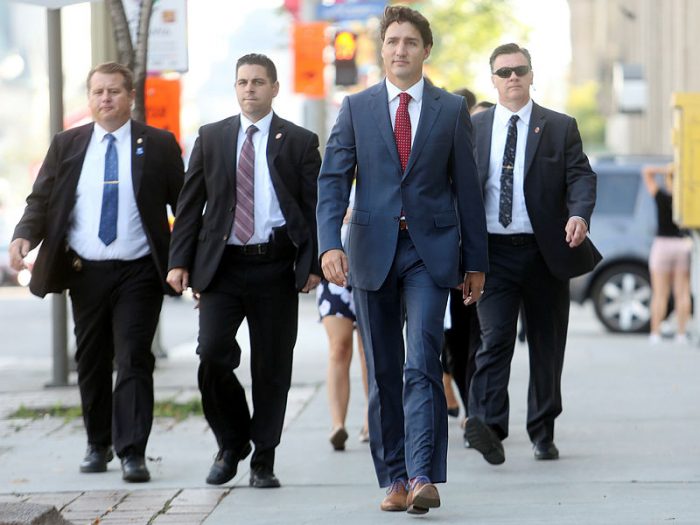
Sources say it’s no accident that six current chiefs of staff used to work in the Prime Minister’s Office.
Several observers said it’s natural for Prime Minister Justin Trudeau, pictured in September, to be dispatching his trusted PMO advisers to ministers’ offices to help those in need. Others suggested it raises the question whether the staffer acts as an agent of the PMO or is there to serve the minister.The HIll Times photograph by Andrew Meade
By SAMANTHA WRIGHT ALLEN
PUBLISHED :Wednesday, Oct. 25, 2017 12:00 AM
The flow of staff from the Prime Minister’s Office to key posts in ministerial offices reveals an underperforming rookie cabinet, increasingly controlled by the PMO despite promises that a Liberal government would reverse Stephen Harper’s centralized approach, say some Conservatives and Liberals.
Many The Hill Times spoke with said this style of governance, coupled with inexperienced MPs in need of support, is a natural outcome of the Canadian parliamentary system that places the prime minister as first among equals. But they pointed out that Justin Trudeau (Papineau, Que.) promised a different approach.
“It should be as absolutely no surprise this is the model that has taken hold. The question is whether the Liberals committed to do something entirely different,” said Michele Austin, who worked as chief of staff to former Conservative public works minister Rona Ambrose.
Mr. Harper, the former Conservative prime minister, trained people in his office and then sent them out as “disciples” to make sure that ministerial offices were “run in the image of the PMO.”
“It looks like generally speaking the [Trudeau] PMO is quite okay with that model and approach,” said Ms. Austin, a senior adviser at Summa Strategies.
Speaking to CBC News two months before his Liberals swept to majority in 2015, Mr. Trudeau was critical of the “trend towards more control from the Prime Minister’s Office,” one he admitted started with his father, former prime minister Pierre Trudeau.
“And I think we’ve reached the end point on that,” he said. He later declared as prime minister that “government by cabinet is back.”
Despite his best intentions, Ms. Austin said she thinks Mr. Trudeau is finding it’s far easier to fall into the habit of governing from the centre.
Of course that movement between cabinet and PMO isn’t one direction, with at least four former chiefs of staff heading into PMO and a further four from PMO taking up posts as policy or communications directors in various offices. Some staff movement is to be expected, noted observers, given the pool of ministerial staff in Ottawa isn’t that large.
In an emailed statement, the Prime Minister’s Office did not directly address any questions or criticisms related to the moves.
Jeremy Broadhurst, pictured in 2016, was in the PMO but moved to work with Foreign Affairs Minister Chrystia Freeland when she took on the high-profile role, keeping the U.S. trade file and NAFTA negotiations. The Hill Times file photograph
“Our government is staffed by a strong team of dedicated professionals,” said press secretary Eleanore Catenaro. “We are proud when these hard-working people from across the country receive new opportunities in government, and when staff in ministers’ offices come to work in PMO.”
While several observers noted this type of movement is typical—and even desirable —for government, insiders who span government relations fields and former Liberal and Conservative staffers, told The Hill Times it’s evidence Mr. Trudeau’s governance style is closer to Mr. Harper than he might like to admit.
“It’s identical, in fact it might even be worse,” said a former Liberal MP who asked not to be named because of the sensitivity of the topic. “You’re starting to see the symptoms of administrations that are that centralized: their ability to consult is diminished, and you get things like the corporate tax structure announcement roll-out, mud on my face, be lucky to get back to zero.”
There are obvious differences, though, given ministers reporting to Mr. Harper had to get their opening statements when appearing at House or Senate committees approved by the PMO, one source said. And, Ms. Austin noted MPs couldn’t come to cabinet unless an item was fully funded in advance or approved by the PMO. Under Mr. Trudeau, she’s heard cabinet has long policy discussions on unfunded items.
Mr. Trudeau might want to edit his 2015 phrase, with the Liberal approach perhaps a case where “discussion by cabinet is back,” she suggested.
Movement between the PMO and ministerial offices is normal and can be for a variety of reasons—a hot file, policy coordination, or stabilizing an office under political heat—said former Conservative staffer Yaroslav Baran, who was chief of staff to the government House leader from 2008 to 2009. One example, sources said, was Ms. Astravas’s move to Mr. Sajjan’s office, because issues management, her PMO focus, was the “No. 1 issue” in his office. Mr. Sajjan got in hot water earlier this year for wrongly saying he was the “architect” of an Afghan military operation.
Early in a government mandate, the PMO tends to be staffed by people close to the prime minister, trusted advisers who form the inner circle.
“Those people then end up often becoming the perfect envoys to later be dispatched to help out ministerial offices in need,” explained Mr. Baran, adding they act as a “trusted link” in times of crisis or if a really important policy file has emerged.
“Often it can end up being greater control—usually it’s greater coordination,” said Mr. Baran
He said perceptions of Mr. Trudeau as hands-off and Mr. Harper as controlling are both “more myth than reality.” Unlike Ms. Austin, Mr. Baran said he knew of few situations where chiefs of staff were appointed under Mr. Harper.
“I think the current government has more PMO influence than is normally believed,” he said.
Several saw it as a weakening of the challenge function to counter PMO, raising the question whether the person acts as an agent of the PMO or is there to serve the minister.
One former Liberal staffer, who also refused to speak on the record in order to be frank and not burn bridges in government, was disappointed by what they said is a growing perception that connection rather than resumé determines who lands in key ministerial jobs, with staff pulled from the inner circle.
“What this seems to suggest more and more…is they have a cabinet of underperformers, that are rookies, that seem to be terrified of independence,” said the source, who is currently working in government relations.
“There’s a lot of the Trudeau cabinet that believes they are doing things much better and differently [than Harper] when in fact they’re very similar,” they said. “There’s this unwillingness to ask or take advice. It just has wasted so much goodwill that has built up.”
And with the party slipping in the polls, “taking direct or indirect control of some ministries is not unexpected,” said former Liberal MP Paul Szabo, adding it’s not unusual to see an inexperienced cabinet struggle at times.
Staffers are moved to and from the PMO and ministers’ offices when the government sees they’ve “got assets” who can help them out. “It’s not nefarious, it’s good strategy,” said Mr. Szabo.
The Hill Times
Staff movement between PMO and ministers’ offices
Cabinet chiefs of staff who came from PMO:
– Jeremy Broadhurst, Foreign Minister Chrystia Freeland’s chief of staff
– Cyndi Jenkins, Veterans Affairs Minister Seamus O’Regan’s chief of staff
– Zita Astravas, Defence Minister Harjit Sajjan’s chief of staff
– Rheal Lewis, Bardish Chagger’s chief of staff as House leader
– Olivier Duchesneau, Ms. Chagger’s chief of staff as small business and tourism minister
– Zoe Caron, Natural Resources Minister Jim Carr’s chief of staff
– Cyrus Reporter, now departed senior adviser in the Prime Minister’s Office, in 2016 worked part-time as interim chief to the justice minister
Staff who left cabinet posts for PMO
– Elder Marques, former Innovation Minister Navdeep Bains’ chief of staff, now PMO senior adviser
– George Young, former chief of staff to the fisheries minister, now PMO ministers’ offices liaison
– Brian Clow, former chief of staff to Ms. Freeland as international trade minister, now heads PMO U.S. relations war room
– Sabina Saini, Treasury Board President Scott Brison’s former chief of staff, now in PMO as deputy director of policy
– Maxime Dea, Maryam Monsef’s former chief of staff at democratic institutions minister last year, now PMO policy adviser
Other PMO-cabinet staffing changes
– Justin To, former PMO policy adviser, moved to Finance Minister Bill Morneau’s office as director of policy
– Mark Kennedy moved to Ms. Chagger’s office as director of communications
– Simon Robertson, former PMO policy adviser, now director policy and parliamentary affairs to Employment Minister Patty Hajdu
– Vheena Bhuller, Mr. Morneau’s former senior special assistant, now PMO youth adviser