
BY: Follow @VictorinoMatus
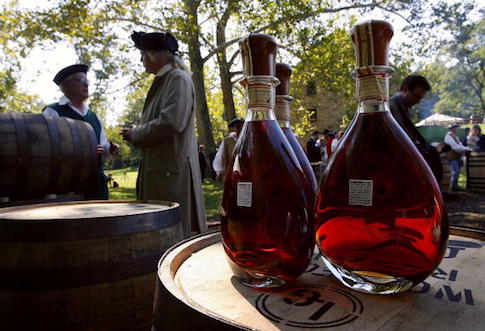
Last month I went down to Mount Vernon, Va., the home of George Washington. But I wasn’t touring the mansion and gardens, where busloads of visitors were milling around. Instead I drove further down the road to the distillery. Yes, aside from being a farmer, general, and our first president, George Washington was a distiller of whiskey.
Mind you the original distillery ceased production in 1814. But 10 years ago, thanks to the Distilled Spirits Council, the Wine & Spirits Wholesalers of America, and generous donors, the distillery was restored and has since been making whiskey using Washington’s actual mash bill: 60 percent rye, 35 percent corn, 5 percent malted barley. Like the rest of the Mount Vernon estate, the distillery is a colonial construction. The workers are dressed in period garb, and they use traditional methods for distillation. (The whiskey itself is for sale in the Mount Vernon gift shop.)
As the mash bill indicates, the whiskey our first president was making was rye, the most common type of whiskey in Washington’s time. (It was also clear, unaged rye, because no one could wait two years for the stuff.) As Reid Mitenbuler points out in Bourbon Empire: The Past and Future of America’s Whiskey, “The grain grows well where other grains don’t, particularly in parts of eastern states like Maryland, New York, Virginia, and Pennsylvania.” But as corn proliferated across the frontier, it replaced rye as the more popular base for whiskey. Then, beginning in the early 2000s, rye made a comeback.
In part it’s because rye is a “flavor grain” added to most bourbon brands, says Mitenbuler, “to help balance corn’s sweetness with rye’s spiciness.” In American Whiskey, Bourbon & Rye: A Guide to the Nation’s Favorite Spirit, author Clay Risen says, “Rye’s strong pepper and fruit notes makes it an obvious member in any cocktail maven’s starting lineup, either as the base for once-again favorites like Sazeracs and Manhattans or as a substitute for bourbon in, say, a mint julep.”
This brings us to the cocktail renaissance that, according to writer Robert Messenger, started around 2004. “It began in our high-end restaurants,” Messenger writes in the Weekly Standard. “A large percentage of profits in such restaurants comes not from the food but from the beverages that accompany it…. Just as these restaurants were educating an urban audience to eat frisée and sweetbreads and to drink Argentine Malbec and Marlborough Sauvignon Blanc, so they eventually began to encourage some chef-like flourishes behind their bars.”
full story at http://freebeacon.com/culture/rye-analysis-return-washingtons-whiskey/