

By Amanda Billner
“No cash accepted” signs are becoming an increasingly common sight in shops and eateries across Sweden as payments go digital and mobile.
Sweden is widely regarded as the most cashless society on the planet. Most of the country’s bank branches have stopped handling cash; many shops, museums and restaurants now only accept plastic or mobile payments. But there’s a downside, since many people, in particular the elderly, don’t have access to the digital society.
“One may get into a negative spiral which can threaten the cash infrastructure,” Dillen said. “It’s those types of issues we are looking more closely at.”
Disappearing Cash
Value of Swedish notes and coins in circulation has dropped to the lowest level since 1990
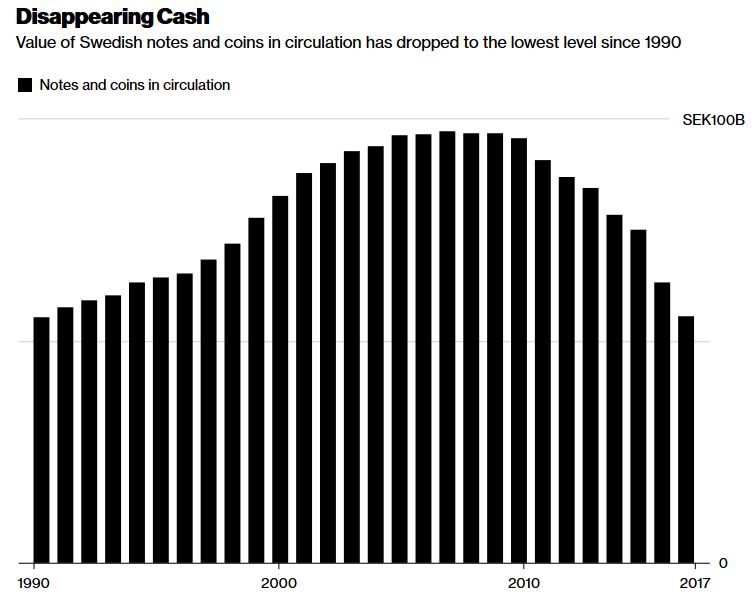
Last year, the amount of cash in circulation in Sweden dropped to the lowest level since 1990 and is more than 40 percent below its 2007 peak. The declines in 2016 and 2017 were the biggest on record.
An annual survey by Insight Intelligence released last month found that only 25 percent of Swedes paid in cash at least once a week in 2017, down from 63 percent just four years ago. A full 36 percent never use cash, or just pay with it once or twice a year.
In response, the central bank is considering whether there’s a need for an official form of digital currency, an e-krona. A final proposal isn’t expected until late next year, but the idea is that the e-krona would work as a complement to cash, not replace it completely.
This version corrects a picture that showed Norwegian kroner.
Riksbank Governor Stefan Ingves has said Sweden should consider forcing banks to provide cash to customers. In its annual report on Monday, the Riksbank said the question is what role it should play in a future with even fewer cash payments.
“The Riksbank is carefully analyzing this development,” Ingves said. “Overall, I think we are facing structural changes in areas that have previously been stable. This is a development which will affect all the Riksbank’s departments and we will need to make strategic decisions regarding the way forward.”
— With assistance by Niklas Magnusson, and Sheldon Reback