
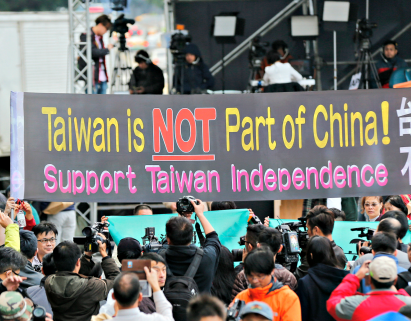

Tensions between the Chinese communists on the mainland of China and capitalists here in the democracy Taiwan are rising. This was confirmed Wednesday as a top official of the Taiwanese Republic of China government told Breitbart News that Taiwan will never “bow to” the communists across the water.
Dr. Chiu Chui-cheng, Taiwan’s deputy minister of mainland affairs who handles relations across the 180-mile-wide Taiwan Strait with mainland China for the democratic government here, said during an interview in his office that the Chinese under Xi Jinping are a serious threat to global stability, safety, and security.
“For the past two years, China has increased its military threat and presence against Taiwan including circling of their aircrafts and vessels including most recently the crossing of the median line above the Taiwan Strait which has not been seen for 20 years,” Chiu said, speaking partially through a government translator, when asked about the rising tensions by Breitbart News. “China’s hegemony has been expanding, and breaking the status quo above not only the Taiwan Strait but also the whole region. Its intentions of invasion and expansion is not only directed at Taiwan, but also around the world.”
Breitbart News is among a group of international media outlets which sent journalists invited here for a series of economic, security, and cultural briefings by the Taipei Economic and Cultural Representative Office (TECRO) in the United States. TECRO is Taiwan’s counterpart to American Institute in Taiwan (AIT), a de facto embassy of Taiwan in the U.S. AIT is the American de facto embassy to here. This informal, unofficial arrangement is necessary because the People’s Republic of China (PRC), the communist government on the mainland, refuses to engage diplomatically with any nation that engages diplomatically with the Republic of China (ROC)—Taiwan’s government—because the PRC contends it is the rightful leader of Taiwan.
The ROC, originally a military dictatorship that later became a democracy celebrating vibrant capitalism in the late 20th century, retreated to Taiwan from mainland China in the late 1940s after World War II when the communists on the mainland led by Mao Zedong won China’s civil war.
The PRC has always contended that the ROC is illegitimate and that it should control Taiwan, even though the communist mainland government has never had control here.
When the ROC fell back to Taiwan, the United States kept diplomatic ties officially for more than two decades with this government but in 1979 under a major cloud of secrecy and bipartisan opposition in Congress then Democrat President Jimmy Carter switched the U.S.’s official diplomatic recognition to the communist mainland government from the ROC here.
In response, an overwhelming bipartisan majority in Congress rallied behind the Taiwan Relations Act which established the deep unofficial ties between the United States and Taiwan, including among other things the U.S. and Taiwan helping each other in the political, business, cultural, and—perhaps most importantly—national defense arenas.
President Carter signed the bill into law, and it has endured since 1979 in paving the framework for the relationship between the U.S. and Taiwan. In addition, later, the United States President Ronald Reagan would issue the “Six Assurances,” clarifying the U.S. position on Taiwan’s sovereignty distinguishing potential misinterpretation of the Three Communiques that established U.S.-PRC relations.