

by James P. Pinkerton
Cold War One
For a period of time, the overseas communist empire had been America’s geopolitical partner. Yet then a string of incidents suggested that maybe the partnership wasn’t so friendly after all; numerous spies were discovered in our midst, responsible for stealing some of America’s most precious strategic secrets. Moreover, a string of American witnesses came forward to offer firsthand accounts of espionage penetrations, and the dangers they posed. And so finally, it became clear to the American people, always reluctant to abandon the hope for peace and friendship, that, yes, the partnership was truly over.
Does this seem to describe the worsening relationship between the U.S. and China over the last two decades—as most Americans have gone from being hopeful that the Chinese economic miracle would lead to democratization, to being fearful of the strategic power of Big Panda?
In the year 2000, President Bill Clinton sat down with the Chinese leadership and agreed that the two countries, the U.S. and China, would enjoy a “constructive strategic partnership.” And the two presidents since Clinton, George W. Bush and Barack Obama, both mostly ignored China as they pursued other goals, such as democratizing Iraq or signing a nuclear deal with Iran. To put that another way, both Bush and Obama were mostly content to leave the warm relationship with China in place, not really noticing that China was taking our jobs, stealing our intellectual property, and growing to be more of a geopolitical menace.
This American naiveté about China has an interesting historical parallel. You see, seven decades ago, there was another warm relationship with a communist power that grew cold. That relationship, of course, was between the U.S. and the Soviet Union, back in the 1940s. Indeed, if we study the trajectory of a warm alliance that deteriorated into a cold war, we can learn some valuable lessons in strategic statecraft—specifically, how America can can keep its footing, even as the international terrain is shifting.
During World War Two, the U.S. and U.S.S.R. had been allies in the war against Germany, and then, at the tail end of the fighting, against Japan, too.
July 1945 marked the high-water mark of that alliance. That’s when the leaders of the United States, the Soviet Union, and Great Britain met in Potsdam, Germany to celebrate the complete defeat, two months earlier, of Hitler’s regime, and to plan for the final vanquishing of Japan, which came the following month. Amidst all those high hopes, many Americans were, yes, naive about the prospect of a constructive U.S.-Soviet relationship in the postwar era.
Yet soon, clear-eyed observers—most notably, Winston Churchill, who coined the phrase “iron curtain” in 1946—saw that the Western vision of a free world was incompatible with Stalinist totalitarianism. Thus the warmth of 1945 became chilly soon thereafter, heading toward the frigidity of the Cold War.
A critical moment in that freezing came in 1948, when the Soviets blockaded truck transport from West Germany to the urban island of West Berlin, that being an enclave of two million German civilians—as well as American, British, and French garrison troops—inside Soviet-controlled East Germany.
The Russian blockade was non-violent; the Red Army simply refused to allow supply trucks to travel the 100 miles from the West German border, through East Germany, to West Berlin. This blockade was technically an act of war, and the Americans could have regarded it as such. Yet in his larger wisdom, President Harry Truman chose to respond in a clever but non-violent manner; he ordered the Berlin Airlift, flying supplies right over the heads of Red Army blockaders—who didn’t dare shoot down the planes and really go to war.
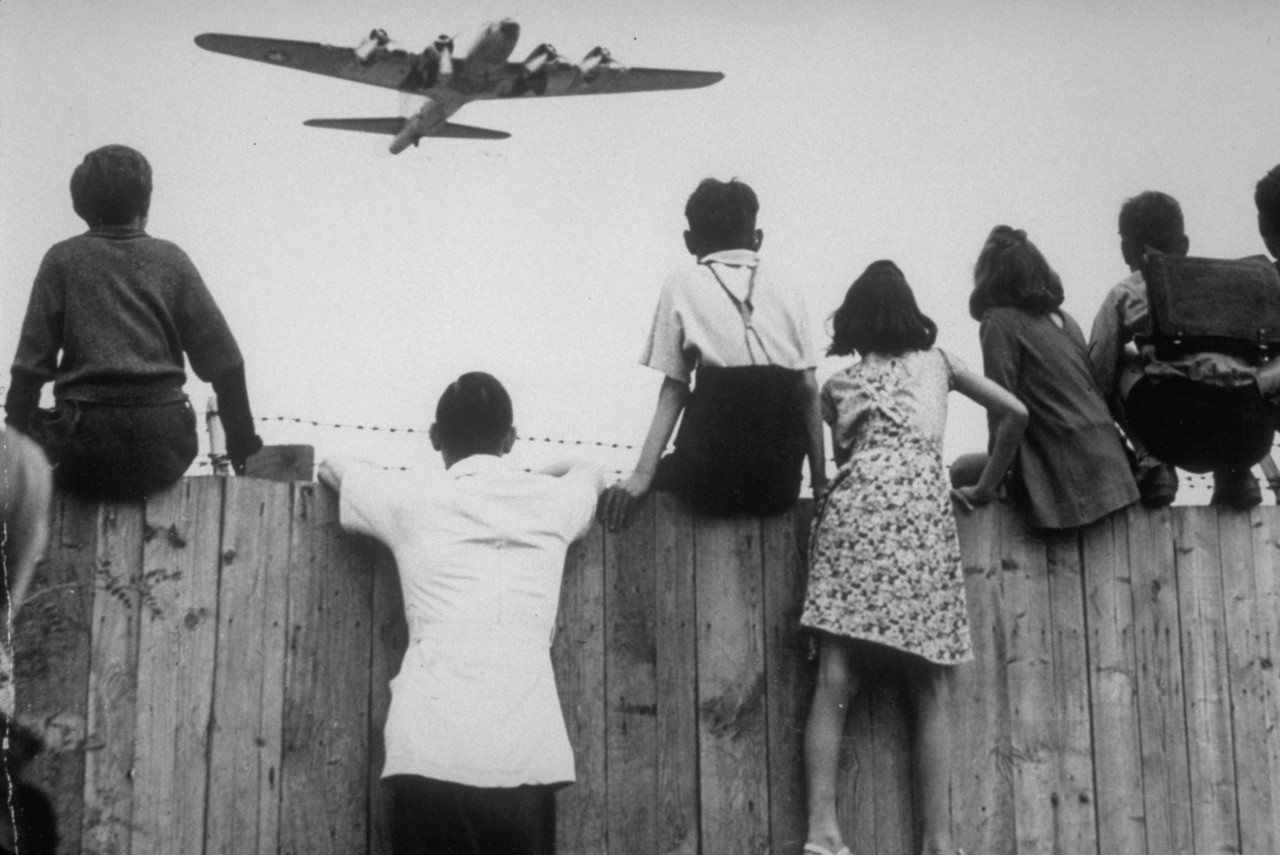
West Berlin children perched on the fence of Tempelhof Airport watch fleets of U.S. airplanes bringing in supplies in 1948 to circumvent the Russian blockade. (Henry Burroughs/AP Photo)
The Berlin Airlift was a wondrous exemplar of American Can Do. In the course of nearly a year, from June 1948 to May 1949, the Americans and their allies flew more than 280,000 flights to West Berlin, delivering more than 2.3 million tons of supplies. After a while, perhaps tired of being embarrassed by this ongoing display of American generosity and logistical virtuosity, the Soviets lifted the embargo. And so the U.S. had won a peaceful, but still signal, victory in the Cold War. (We should, however, remember the 70 American and British airmen who gave their lives in this effort, killed in crashes and other accidents.)
The Berlin Airlift showed how the U.S. could wage the Cold War, winningly yet peacefully.
In fact, West Berlin was soon the backdrop for another winning Cold War moment. In June 1963, President John F. Kennedy traveled there to deliver the stirring words of solidarity, Ich bin ein Berliner (I am a Berliner), to a cheering crowd, delighted that JFK had spoken their language. On that day, on the new electronic stage of television, the light of a brave young president glowed for all the world to see.
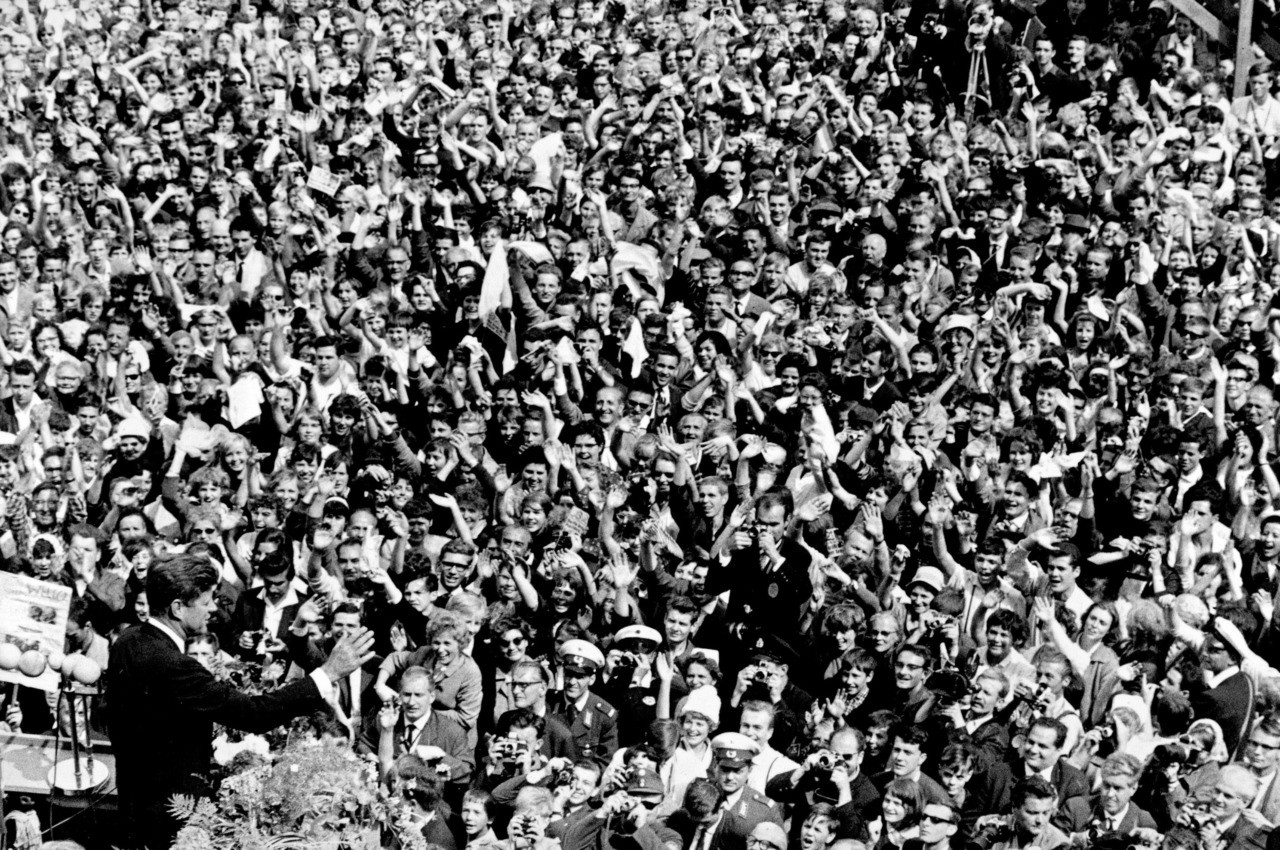
President John F. Kennedy, left, waves to a crowd of more than 300,000 gathered to hear his speech in the main square in front of Schoeneberg City Hall in West Berlin. (File/AP Photo)
Cold War Two
We can add that the defense of a free city against communist encroachment is not just history; it’s also happening now, in our time, as Chinese communists threaten the liberty of Hong Kong. In fact, a poignant July 16 headline in Foreign Policy reads, “Ich Bin Ein Hong Konger”—a play, of course, on the 35th president’s speech of a half-century before. As author Melinda Liu explained, “Hong Kong is turning into the West Berlin of the quasi-cold war between the West and China.”
So what is the 45th president doing about Hong Kong? So far, Donald Trump hasn’t said much of anything. Why? Part of the reason is that the situation, then and now, is different; whereas West Berlin, in JFK’s day, was a sovereign non-Soviet territory, Hong Kong, in DJT’s time, is formally a part of the People’s Republic of China—and has been for more than two decades. In other words, even if he wanted to, Trump couldn’t just hop on a plane and go to Hong Kong—it’s somebody else’s country.
Moreover, Trump is currently in the midst of delicate trade negotiations with the People’s Republic. It must be noted that in world politics, the goal of preserving freedom for Hong Kong must always be weighed against all other American goals.