
by Bruce Bawer
Relegating a high-profile celebration of patriotism to the dustbin of history
Bruce Bawer is a Shillman Fellow at the David Horowitz Freedom Center.
The first thing to know is that the BBC was never objective. In the 1930s, when Churchill was repeatedly warning his fellow members in Parliament about the dangers of Nazi Germany, the BBC refused him airtime to share his warnings with the general public. In the 1950s, BBC honchos fought tooth and nail against the breakup of their monopoly that finally permitted the introduction of commercial television.
Yes, Thatcher reformed the BBC. But after she was gone, Labour swiftly un-reformed it. Since then, the contents of programs on the Beeb, all of them financed by a hefty license fee extorted from British subjects on threat of imprisonment, have increasingly reflected the social attitudes, political opinions, and cultural tastes of hard-left north London nobs. During the Brexit debate, the Corporation systematically celebrated the EU and depicted Leave supporters as rubes, xenophobes, morons, and “Little Englanders.” Former BBC journalist Robin Aitken MBE, author of a book called Can We Trust the BBC?, recently complained that the BBC “doesn’t have the pulse of the country,” that it “portrays Britishness…in a negative light,” and that its slant is “quite Soviet in its intensity and its ubiquity.” In the run-up to the last general election, Boris Johnson dangled in front of voters the possibility of abolishing the BBC license fee.
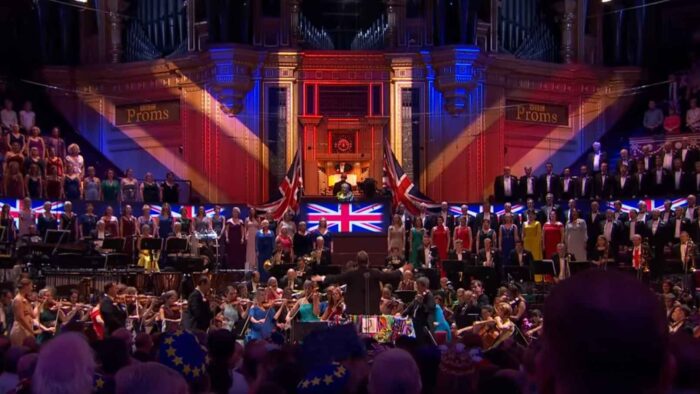
Year in and year out, perhaps the only high-profile regular broadcast on the BBC that isn’t poisoned by far-left politics has been the Last Night of the Proms, the annual concert, aired live from Royal Albert Hall, at which audience members proudly wave the Union Jack and the BBC Symphony Orchestra rounds out the evening with lush, rousing arrangements of “God Save the Queen” and the traditional songs “Jerusalem,” “Land of Hope and Glory” and “Rule, Britannia.”
These songs are, for one thing, powerful statements of patriotism. For another, they’re also invaluable parts of Britain’s cultural heritage. The men who created them are among Britain’s most accomplished musical artists. “Rule Britannia,” with words by Scottish poet James Thomson, author of The Castle of Indolence, and music by Thomas Arne, dates back to 1740. “Jerusalem,” one of the most famous poems by one of Britain’s great Romantic poets, William Blake, was set to music in 1916 by Sir Hubert Parry; Sir Edward Elgar, one of Britain’s great composers, is responsible for the now-famous orchestration. “Land of Hope and Glory” was originally a melody from Pomp and Circumstances March No. 1, composed by Elgar in 1901 and familiar to most Americans because it’s been played at generations of U.S. high-school graduations; at the suggestion of King Edward VII, the melody was isolated from the larger work and words added by A.C. Benson so that it could be performed at the king’s 1902 coronation.
Several of the Last Night of the Proms performances can be viewed on YouTube. I’ve watched them over and over again, because, at a time when Brits who dare to put a flag in their front windows should be prepared for a visit from the cops, I find the unashamed displays of national pride by Proms audiences cheering. To watch the audiences proudly sing the lyrics to these masterpieces leads me to think that perhaps there is a silent majority of Brits who, when push comes to shove, won’t let their country be brought down by woke metropolitan crazies who treat the Quran with more reverence than Magna Carta.
full story at https://www.frontpagemag.com/fpm/2020/08/canceling-british-pride-bruce-bawer/