
By Paul J. Larkin, Jr.
The executive branch of George Washington’s presidency was but a pale image of what we have today. The 91 members of the first Congress outnumbered the executive branch officials empowered to implement congressional acts and presidential orders. Since Congress chartered the Interstate Commerce Commission in 1887, however, the number, reach, and power of executive officials have grown exponentially, creating our contemporary Leviathan administrative state.
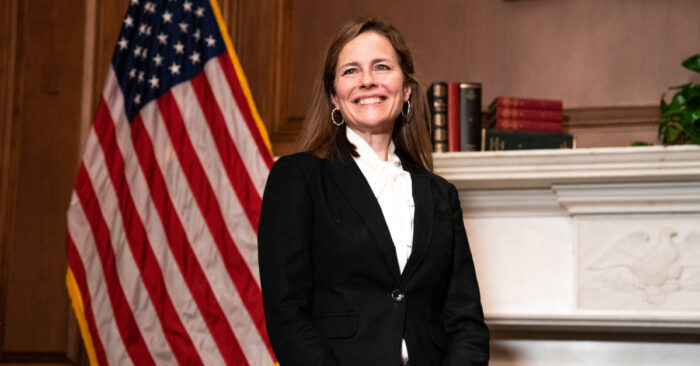
A major criticism of the administrative state is that it consists of unelected officials with the power to govern virtually every aspect of modern life without serious oversight by the federal courts. That issue might arise during the upcoming Senate Judiciary Committee hearings for Judge Amy Coney Barrett, President Donald Trump’s nominee for the current opening on the U.S. Supreme Court.
Barrett, a judge on the U.S. Court of Appeals for the Seventh Circuit, has been on the bench for less than three years, so her judicial oeuvre is relatively small. Nonetheless, critics of her nomination — both those fearful of how she might vote as a Supreme Court justice and those who just hate Trump and anything he does — will dissect every paragraph and sentence of every opinion and article she has written in the hope of finding some nugget that gives a senator opposing her the opportunity for a “J’accuse!” moment during her scheduled Senate Judiciary Committee hearing or likely Senate floor debate.
Barrett’s authored opinions give no reason to believe she automatically accepts or rejects an agency’s interpretation of the law. For example, consider her dissenting opinion in the controversial case of Cook County, Illinois v. Wolf. The administrative law issue in Wolf involved the proper application of the Supreme Court’s decision in Chevron U.S.A., Inc. v. Natural Resources Defense Council, Inc., which directs federal courts to accept a reasonable interpretation of an ambiguous federal law, even if the court would read the law differently.
Wolf involved the Trump administration’s “public charge” rule, which is designed to limit the ability of noncitizens who are likely to become reliant on the nation’s numerous welfare programs to enter or remain in this nation. By a 2-1 vote, the Seventh Circuit concluded that the Department of Homeland Security’s rule was unreasonable.
full story at https://thefederalist.com/2020/10/08/amy-coney-barretts-decisions-are-a-threat-to-big-unaccountable-government/