
by Bruce Thornton
Endangering our military preparedness and national security.
Bruce Thornton is a Shillman Journalism Fellow at the David Horowitz Freedom Center.
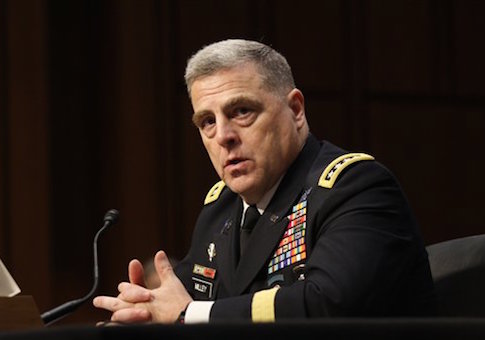
General Mark Milley, Chairman of the Joint Chiefs and the military’s highest-ranking officer, according to Bob Woodward and Robert Costa’s new book took actions in the waning days of the Trump administration that are plausible predicates for charges of treason. This blatant violation of his oath to uphold the Constitution and its subordination of the military to the civilian government accountable to the people, must be further investigated and if substantiated, appropriately punished. But the institutional dysfunctions of the modern military establishment transcend any one man.
On the preposterous pretext that President Trump is mentally unstable enough to attack China or provoke a nuclear war before leaving office, Milley allegedly overstepped his Constitutional authority and violated the chain of command by going behind Trump’s back to speak with a foreign power. As a National Review editorial reported, Milley “went to the head of the Chinese military to tell him, in effect, that Trump was bluffing. He reportedly ordered naval exercises canceled to avoid offending the Chinese. He even ‘went so far as to pledge he would alert his counterpart in the event of a U.S. attack . . . “General Li, you and I have known each other for now five years. If we’re going to attack, I’m going to call you ahead of time. It’s not going to be a surprise.’”
This blatant politicizing of his office bespeaks personal careerism and an inflated ego, as well as the insular culture of our bureaucratized military establishment, all of which compromises our national security.
These dysfunctions of military leadership were memorably expressed by Army Colonel David Hackworth in his phrase “perfumed princes,” the Pentagon’s top brass more concerned with politics and their own career advancement than with their duty to the troops and national security. In part such criticism of generals has been a perennial feature of militaries. In World War I it was expressed by the famous description of the allied soldiers as “lions lead by donkeys.” Constitutional governments traditionally distrust officers and generals, given their military skills and control over armies and weapons, which make them a risk for engineering coups. That’s why the Founders made the president, whether a veteran or not, the commander-in-chief, and feared standing armies.
But the rise of technocratic progressivism, which multiplied and enlarged government agencies and the power of the executive that controls them––including what once was called the War Department, but now is known as the Department of Defense––further politicized our military. This name-change reveals one development that has altered our perceptions of the use of force: the idealistic foreign policy of the “rules-based international order” that privileges multilateralism, “soft power,” international institutions, and “diplomatic engagement” over the unilateral use of force.
This foreign policy orthodoxy, necessarily political, now dominates our top-tier military leadership. Those officers who wish to rise in the hierarchy must show obeisance to this questionable foreign-policy philosophy. This allegiance explains much of the resistance to Trump and the undermining of his foreign policy decisions on the part of some of his military advisors and cabinet appointees.
full story at https://www.frontpagemag.com/fpm/2021/09/general-milley-and-perfumed-princes-pentagon-bruce-thornton/