
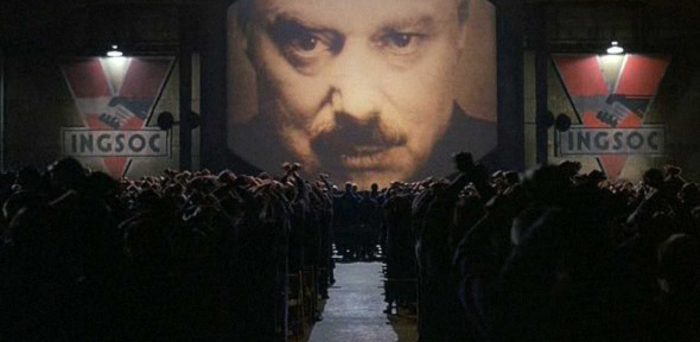
In his classic dystopian novel 1984, George Orwell famously wrote, “If you want a picture of the future, imagine a boot stamping on a human face—for ever.” This striking image served as a potent symbol for totalitarianism in the 20th Century. But as Caylan Ford recently observed, with the advent of digital health passports in the emerging biomedical security state, the new symbol of totalitarian repression is “not a boot, but an algorithm in the cloud: emotionless, impervious to appeal, silently shaping the biomass.”
Other advanced technologies were deployed in what one writer has called, with a nod to Orwell, “the stomp reflex,” to describe governments’ propensity to abuse emergency powers. Twenty-two countries used surveillance drones to monitor their populations for covid rule-breakers, others deployed facial recognition technologies, twenty-eight countries used internet censorship and thirteen countries resorted to internet shutdowns to manage populations during covid. A total of thirty-two countries have used militaries or military ordnances to enforce rules, which has included casualties. In Angola, for example, police shot and killed several citizens while imposing a lockdown.
Orwell explored the power of language to shape our thinking, including the power of sloppy or degraded language to distort thought. He articulated these concerns not only in his novels Animal Farm and 1984 but in his classic essay, “Politics and the English Language,” where he argues that “if thought corrupts language, language can also corrupt thought.”
The totalitarian regime depicted in 1984 requires citizens to communicate in Newspeak, a carefully controlled language of simplified grammar and restricted vocabulary designed to limit the individual’s ability to think or articulate subversive concepts such as personal identity, self-expression, and free will. With this bastardization of language, complete thoughts are reduced to simple terms conveying only simplistic meaning.
Newspeak eliminates the possibility of nuance, rendering impossible consideration and communication of shades of meaning. The Party also intends with Newspeak’s short words to make speech physically automatic and thereby make speech largely unconscious, which further diminishes the possibility of genuinely critical thought.
In the novel, character Syme discusses his editorial work on the latest edition of the Newspeak Dictionary: