
By
In March 2023, the UN Water Conference was held in New York, co-hosted by the governments of the Netherlands and Tajikistan. It is the first time this conference has been held in 46 years; the first was held in Argentina in 1977.
“We hope it could result in a “Paris moment” for water – with outcomes as critical for water as the Paris Agreement has been for climate action,” Henk Ovink and Sulton Rahimzoda said.
Ovink is the Special Envoy for International Water Affairs for the Kingdom of the Netherlands. Rahimzoda is the Special Envoy of the President of the Republic of Tajikistan to the Water and Climate Coalition Leaders.
On the Conference’s website, the UN notes: “Water is a dealmaker for the Sustainable Development Goals … But our progress on water related goals and targets remains alarmingly off track, jeopardising the entire sustainable development agenda.” It titles its project as “Uniting the world for water.”
The same webpage showcases a suitably dramatic quote from UN Secretary-General António Guterres:


Officially titled the ‘The United Nations Conference on the Midterm Comprehensive Review of the Implementation of the Objectives of the International Decade for Action “Water for Sustainable Development,” (2018-2028)’, the UN Water Conference aimed to raise awareness of the global water crisis and decide on action to achieve internationally agreed water-related goals.
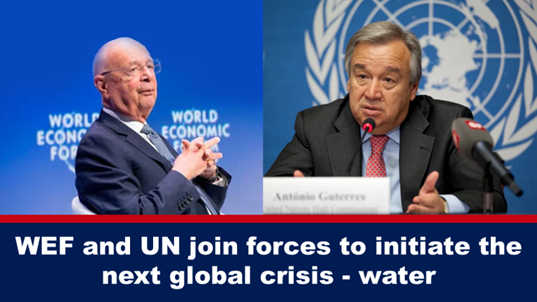
Well, that was the aim as stated in an article by Ovink and Rahimzoda and published by the World Economic Forum (“WEF”) in March 2023, a week before the Conference began. But according to a WEF press conference held six months earlier, they’re not telling the truth.
WEF held a press conference to launch its Global Commission on the Economics of Water during its 2022 annual meeting. At this press conference, one of the Commission’s chairs let the cat out of the bag as to why they were focusing on the world’s water supply.
The first clue is something WEF wrote about the launch in the summary at the top of Ovink and Rahimzoda’s article: “The Global Commission on the Economics of Water, launched at the World Economic Forum Annual Meeting in 2022, will report on game-changing ways to value and manage water as a common good.”
The key phrase is “common good.”
The common good is a collectivist term used for social control. Collectivism takes many forms: socialism, fascism, Nazism or National Socialism, welfare statism and communism. As German Nazi politician Hermann Goering said, the highest principle of Nazism is “common good comes before private good.”