
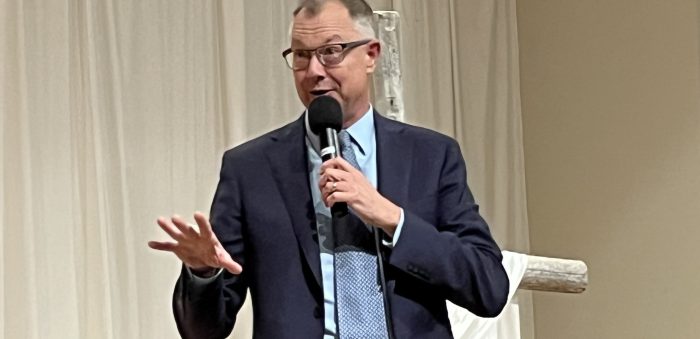


“You don’t place somebody under house arrest because they might commit a crime in the future. This is sick, this is twisted, it’s dangerous and it’s scary.”
At a town hall meeting in Ottawa Thursday night, Justice Centre for Constitutional Freedoms president John Carpay said the “scariest provision” of Prime Minister Justin Trudeau’s Online Harms Act is the “preemptive punishment of people who have not committed any crime.”
Carpay was referring to the Liberal government’s latest censorship law, Bill C-63, that includes a thought crime component where people suspected of harboring “hateful speech” can be placed under house arrest and prevented from communicating over the internet.
“This is terrifying, you know, that you can get these restrictions placed on you, house arrest, curfew,” Carpay told a packed crowd at the West Ottawa Community Church.
“You don’t place somebody under house arrest because they might commit a crime in the future. This is sick, this is twisted, it’s dangerous and it’s scary,” Carpay continued, noting that the Trudeau government is justifying its law by saying it protects children.
“So if this Bill C-63 passes, it’s going to result in a situation where if I fear that you are going to commit a hate crime, hate speech, anti-semitism, whatever, I can file a complaint and I can force you to appear before a provincial court judge and I can say that I fear that you are going to say something hateful and if the judge thinks that I have reasonable grounds for my fear, he can order you under house arrest, ankle bracelets, curfew, abstain from alcohol or drugs, provide blood or urine samples to prove that you’re not taking alcohol or drugs [and] confiscate your legally-owned firearms,” Carpay said.