
by
This article was originally published by Radio Free Europe/Radio Liberty and is reprinted with permission.
In October 2024, the US Coast Guard spotted two Chinese maritime enforcement vessels operating alongside a pair of Russian border patrol boats as they transited the Bering Sea, just kilometers from Alaskan waters.
It was the third consecutive year that a joint Russian-Chinese military convoy sailed through the strategic waterway. A year earlier, the two nations staged joint naval exercises in the region with 11 ships — a clear signal of their growing military cooperation near US territory.
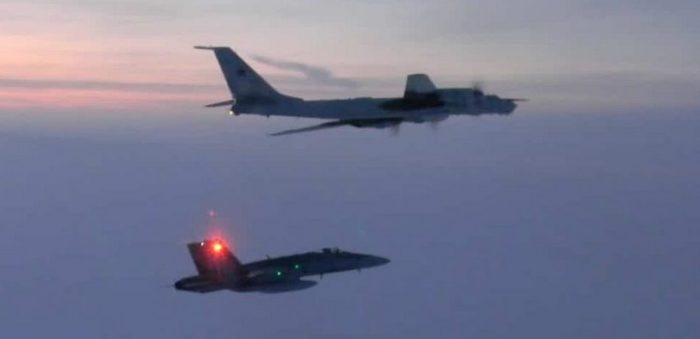
The October transit, which China said continued through the Bering Strait into the Arctic Ocean, came less than three months after the first joint flight of Chinese and Russian strategic bombers over the Bering Sea.
The uptick in Russian and Chinese activity near Alaska — home to America’s largest fleet of advanced fighter jets and a cornerstone of its missile defense architecture –is fueling calls to reestablish Cold War-era military infrastructure on the Aleutian Islands.
Admiral Samuel Paparo, commander of US Indo-Pacific Command, told the Senate Armed Services Committee on April 10 that he supports reopening the shuttered naval facility on Adak Island and upgrading Eareckson Air Station on Shemya, the westernmost outpost of the chain.
Facilities on Adak and Shemya would give the United States “time and distance on any force capability that is looking to penetrate” American waters or airspace, Paparo said. Reactivating Adak would allow the United States to increase maritime patrol and reconnaissance aircraft (MPRA) coverage in the region by a factor of 10, he told lawmakers.
A Gateway To The Arctic
The Aleutian chain, made up of 14 large volcanic islands and 55 smaller ones, stretches more than 1,600 kilometers from the Alaskan mainland toward Russia’s Kamchatka Peninsula. The islands sit astride the great circle routes, the shortest paths between Asia and North America, and serve as a gateway to both the Arctic Ocean and Bering Sea.
Kamchatka — 800 kilometers west of Shemya — is home to Russia’s Pacific submarine fleet and squadrons of long-range fighters. Paparo described Russia’s Pacific Fleet as a “growth enterprise” that now operates “frequently” along the great circle routes.
General Gregory Guillot, commander of the US Northern Command, testified in February before a Senate committee that reviving Adak could provide important “maritime and air access.”