
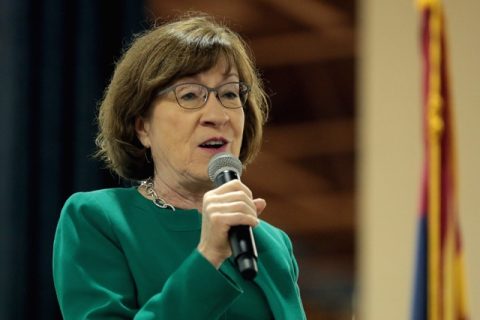
In a major development that could reshape the future of federal election law in the United States, Senator Susan Collins (R-ME) has officially announced her support for the SAVE Act.
With Vice President JD Vance prepared to break a tie if necessary, supporters of the legislation now say they have the numbers needed to pass the bill under a standing or “talking” filibuster scenario, marking a potential turning point in the GOP’s long-running effort to implement nationwide voter ID and proof-of-citizenship requirements for federal elections.
It can be recalled that Rep. Anna Paulina Luna revealed that Senate leadership is moving toward nuking the so-called “Zombie Filibuster” and restoring an old-school standing filibuster to advance the SAVE America Act, legislation that requires proof of U.S. citizenship to vote.
According to Luna, John Thune signaled after a meeting with Donald Trump that the Senate is prepared to bring the SAVE Act to the floor without the modern, abuse-ridden 60-vote blockade.
Senator Mike Lee (R-UT) celebrated the news:
“I’m thrilled to receive the news that Senator Susan Collins has announced her support for the SAVE America Act! This is huge!”
Collins had previously expressed reservations about earlier iterations of the legislation, particularly provisions that would have required voters to present proof of citizenship, such as passports or birth certificates, each time they cast a ballot.
However, according to reporting from The Maine Wire, the current House-passed version of the SAVE America Act has removed that requirement, instead allowing state-issued identification to suffice, an adjustment Collins says was critical in securing her support.
“Requiring voters to produce passports or birth certificates on election day — as opposed to just a state-issued ID — would have placed an unnecessary burden on the voters. That provision is no longer in the bill and dropping this requirement was key to getting my support,” Collins said.
“The law is clear that in this country only American citizens are eligible to vote in federal elections,” Collins added.