
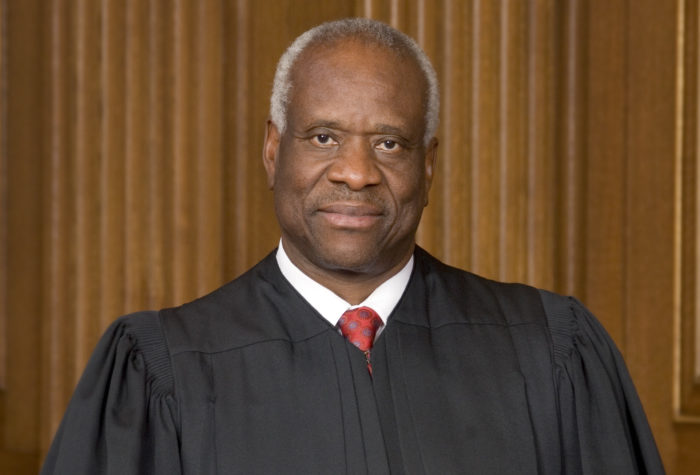


Supreme Court Justice Clarence Thomas joined two of his colleagues in dissenting from an unfortunate opinion.
On Friday, according to The Carolina Journal, SCOTUS ruled 6-3 that, under the 1977 International Emergency Economic Powers Act, President Donald Trump does not have the authority to impose tariffs, a power the U.S. Constitution assigns to the legislature.
In a separate dissent, Thomas insisted that the high court’s majority got it wrong.
The legendary conservative justice argued that while Congress may not delegate its “core legislative power,” it may delegate (and many times has delegated) enumerated powers such as the tariff-making power.
“Because the Constitution assigns Congress many powers that do not implicate the nondelegation doctrine, Congress may delegate the exercise of many powers to the President. Congress has done so repeatedly since the founding, with this Court’s blessing,” Thomas wrote. “The power to impose duties on imports can be delegated.”
In 2025, Trump invoked IEEPA as a statutory justification for his sweeping tariffs.
Crucially, IEEPA’s Sec. 203 authorized the president to “investigate, regulate, direct and compel, nullify, void, prevent or prohibit, any acquisition, holding, withholding, use, transfer, withdrawal, transportation, importation or exportation of, or dealing in, or exercising any right, power, or privilege with respect to, or transactions involving, any property in which any foreign country or a national thereof has any interest; by any person, or with respect to any property, subject to the jurisdiction of the United States.”
Assuming one could even imagine a broader delegation of emergency powers, one wonders if human language could express it.
Indeed, both Thomas and Justice Brett Kavanaugh placed proper emphasis on the words “regulate” and “importation.”