
On June 21, far-right lawyer Abelardo de la Espriella defeated leftist senator Iván Cepeda to become Colombia’s new president. De la Espriella, a political newcomer endorsed by President Trump, ran on a platform of tougher security, ending peace talks with rebel groups, expanding oil and gas production, and lowering taxes, directly reversing the policies of outgoing leftist President Gustavo Petro.
With the shift in Colombia, nine Latin American countries now have right-leaning governments, a regional trend that began accelerating in late 2023 and has continued through mid-2026. Conservative and right-wing forces have dominated Latin America’s political leadership since 2025 for the first time in many years, with the proportion of Latin Americans identifying as center-right reaching its highest level in more than two decades.
The Biden presidency coincided with the peak of the second Pink Tide in 2022-2023, when only five countries, Ecuador, El Salvador, Guatemala, Paraguay, and Uruguay, stood outside leftist control. As a result, roughly 13 of Latin America’s 18 major countries had left-leaning or center-left governments.
Of those, at least seven were openly socialist or further left. Peru’s Pedro Castillo ran on an explicit socialist platform before being jailed after attempting to dissolve the government. Colombia’s Gustavo Petro, a former M-19 guerrilla, became the country’s first left-wing president in its 212-year history. Honduras’s Xiomara Castro governed as a self-described democratic socialist, while Bolivia’s Luis Arce maintained the MAS movement’s socialist agenda financed through state extractivism.
The blue wave continued through Panama and El Salvador in 2024 and gathered momentum in 2025 with right-wing victories in Ecuador, Bolivia, Honduras, and Chile. Costa Rica added to that count in February 2026, when right-wing candidate Laura Fernández won the first round with 48.6% of the vote. Runner-up Álvaro Ramos Chaves also belonged to the center-right.
Colombia followed in June 2026, and Peru appears set to do the same, with conservative candidate Keiko Fujimori projected to win pending final certification. The last major test of whether the wave holds is Brazil, where Lula faces Flávio Bolsonaro in the first round of the October 2026 election.
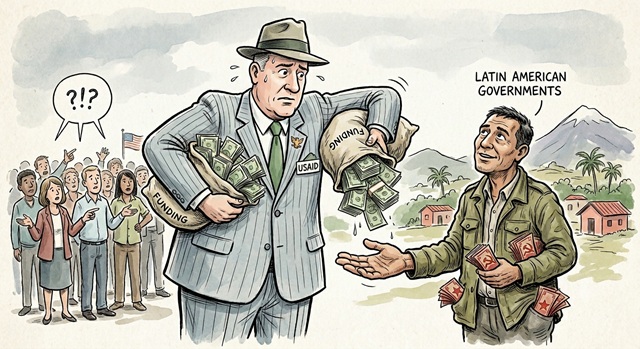
In addition to coinciding with President Trump’s second term, the decline of socialism in Latin America accelerated following USAID cuts enacted by the Trump administration. On January 20, 2025, his first day back in office, Trump signed Executive Order 14169, “Reevaluating and Realigning United States Foreign Aid,” imposing an immediate pause on foreign assistance pending review.
By March 10, Secretary of State Marco Rubio announced that 83 percent of USAID programs had been eliminated, representing 5,200 contracts. On July 1, 2025, USAID formally ceased operations and was absorbed into the State Department.
USAID and the State Department had been responsible for roughly 90 percent of the approximately $3 billion annual U.S. democracy aid budget globally, with the National Endowment for Democracy accounting for the remainder. That funding supported NGOs, civil society organizations, media projects, and election-monitoring programs across Latin America for decades, consistently backing left-wing causes and left-leaning governments.
In 2024, USAID awarded a $2 million grant to Asociación Lambda in Guatemala to fund sex-change operations and related treatments, including hormone therapies and puberty blockers. It also funded transgender-themed artistic initiatives in Colombia and Peru, while its Democracy, Rights and Governance election-integrity arm operated alongside those programs.