
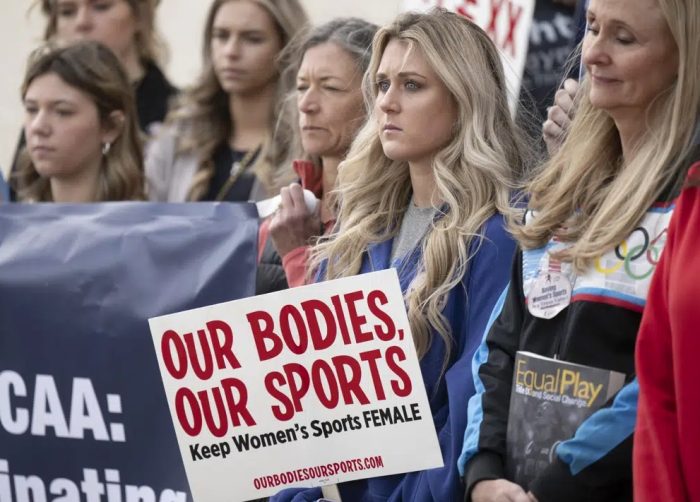


The cases were brought by challengers to those state allowances in West Virginia and Idaho.
The Supreme Court handed down a ruling on Tuesday addressing the practice in many states of allowing boys who claim to be girls and men who claim to be women to play in girls’ and women’s sports. The cases, which were combined for the court’s ruling, were brought by challengers to those state allowances in West Virginia and Idaho.
The court ruled that Title IX allows schools to separate sports based on biological sex. The court also held that “West Virginia and Idaho did not violate the Equal Protection Clause of the Fourteenth Amendment by maintaining female sports teams for biological females.”
Delivering the opinion for the court, Justice Brett Kavanaugh wrote, “Separate sports teams for biological males and biological females are reasonable: Given the inherent physical differences between the sexes, allowing only biological females to play on women’s and girls’ teams can reduce the risk of physical injury and ensure fair competition.”
“True, some might prefer a different rule allowing biological males who identify as female to participate on women’s and girls’ sports teams, at least in certain circumstances. But it was surely “reasonable” for HEW in 1975 to draw a biological line—a line where biological males play only on male sports teams and only biological females play on female sports teams. Even in recent years, 27 States, the NCAA, the USOPC, and the IOC have all drawn the same line.”
Kavanaugh wrote that allowing biological males to play on female sports teams “can put women and girls at significant risk of injuries. The safety risks are particularly severe in contact sports.” Regarding competitive fairness, he weote, “allowing biological males to play on women’s and girls’ sports teams can put female athletes at a serious disadvantage. That is because sports are generally zero sum. Allowing a biological male athlete to compete on a girls’ team necessarily displaces or disadvantages a female athlete—replacing her on the roster, knocking her out of the starting lineup, reducing her playing time, depriving her of a medal, and the like.”
“That hard reality of sports cannot be ignored or swept under the rug. On the contrary, that reality must and does inform interpretation of the term “reasonable” in the Javits Amendment.”