
by
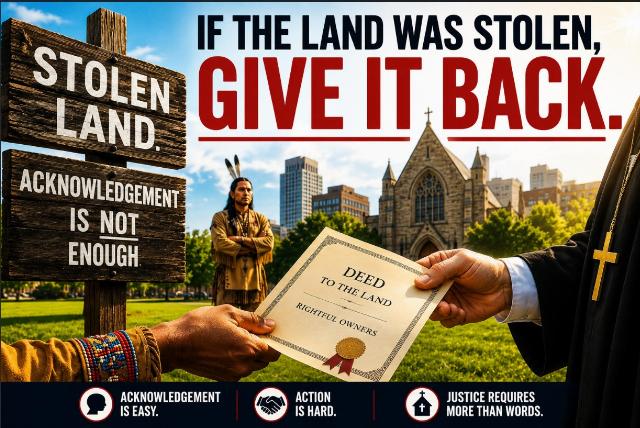
Words are cheap. Deeds are not.
Recently, I was invited to attend a Sunday service at a Methodist church rather than my regular church.
The congregation was small, perhaps a few dozen people. Before the service began, the pastor introduced herself, shared her preferred pronouns, and then solemnly informed us that we were gathered on stolen land.
The land, she explained, once belonged to Native American tribes that lived in the area long before Denver existed.
I sat quietly and listened. Then a simple question occurred to me.
If the land was stolen, why are we still sitting on it? To my knowledge, the church owns the valuable piece of property in an upscale Denver neighborhood.
If I knowingly occupy stolen property, I have a moral obligation to return it to its rightful owner. Merely acknowledging that it was stolen does not absolve me of responsibility.
Yet this is precisely the logic behind the modern ritual of land acknowledgments.
Over the past several years, universities, churches, government agencies, nonprofit organizations, and even sporting events have begun opening meetings with statements recognizing that they occupy land once inhabited by indigenous peoples.
These declarations have become almost mandatory among progressive institutions. They are delivered with great solemnity, usually without anyone asking the obvious follow-up question.
When will you be giving the land back?
The answer, of course, is never.
The contradiction is difficult to miss.
If these institutions genuinely believe they are occupying stolen property, then the moral solution seems straightforward. Transfer the deed. Return the property. Relocate somewhere else.
A church could return its land.
A university could return its campus.
A presidential library could return its grounds.
Yet no one proposes doing so.
Instead, we get speeches.
At the recent opening of the Obama Presidential Center, former Obama advisor Valerie Jarrett recognized the “original inhabitants” of the land and honored several Native nations associated with the region.
But if the property truly belongs to those groups, why stop at acknowledgment?
Why not transfer ownership?
Why not place the land into a tribal trust?
Why not demonstrate sincerity through action rather than symbolism?
Everyone already knows the answer. The acknowledgment costs nothing. Returning the property would cost something.
That distinction matters.
The deeper problem is that the entire concept quickly collapses under scrutiny.
Who exactly are the rightful owners?