
Author: Gwyn Morgan
Diversifying our international trading markets seems a sensible enough strategy for Canada, but Prime Minister Mark Carney’s fixation on closer ties with Europe is anything but.
With Canada-U.S. free-trade negotiations still stalled — recent news chatter of talks restarting notwithstanding — the PM is pursuing expanded trade and stronger political ties with Europe.
His move raises two questions: What is the point, and why would Canada want closer relations with Europe at all?
Canada already has a free trade agreement with the European Union: the Comprehensive Economic and Trade Agreement (CETA). Signed in 2016, it covers nearly all trade in goods and many services.
Since it took effect, two-way trade has nearly doubled to an estimated $195 billion last year, with a reported 99 percent of goods crossing borders tariff-free.
Canada also has the Trade Continuity Agreement with Great Britain, which replicates CETA almost word-for-word, and a separate agreement with the European Free Trade Association countries of Iceland, Liechtenstein, Norway and Switzerland.
Together, these agreements have helped drive Canada–Europe trade to nearly $300 billion annually. Still, some individual EU countries still haven’t implemented CETA — so those would be good, specific tasks to focus on.
Given all of this, what does Carney’s talk of “turning to Europe” mean exactly?
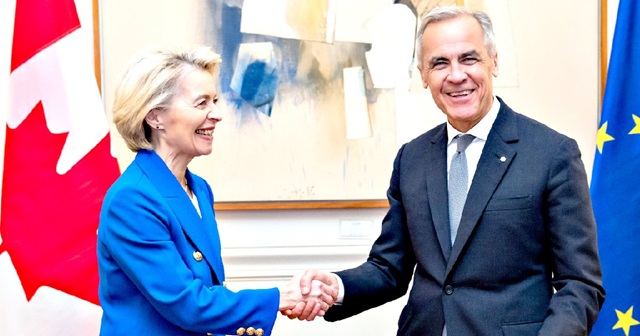
If it means becoming an “associate” member of the EU, as European Commission President Ursula von der Leyen announced in late summer, Carney later confirmed, and both politicians reiterated in late October, Canadians should understand that EU membership involves much more than trade.
The EU is no mere economic bloc, but a political confederation in which the European Parliament — and, even more, the powerful European Commission — has powers superior to the governments of member countries.
This relationship substantially erodes, if not erases, the sovereignty of member nations.
It was what drove Britain to exit the EU via its “Brexit” vote in 2016. Several other nations are threatening to do so as well, while many others are in constant battle with the Eurocrats in Brussels.
And Carney wants to join?
As Gina Pappano explained in a recent C2C Journal article, the implications could be particularly serious for Canada’s natural resource-producing provinces.
The second question is why Canada would want closer relations with Europe at all.
Former European Central Bank President Mario Draghi has described it as “a society facing a slow agony of decline.” If the slide continues, he warned, “the continent will progressively lose the ability to fund the core functions of a modern state.”
The continent faces economic stagnation and deindustrialization, while political and immigration crises deepen. The ongoing violent riots and horrific destruction we’re seeing right now all over France are taking the “slow” out of Draghi’s warning.
Canada signing on with the dysfunctional, declining, over-regulated yet increasingly lawless EU would thus be like boarding an ocean liner that’s already sinking.