

By Jack
Okay, now let’s separate the real Iowa shock from the internet overreach.
The statewide swing was enormous. The registration numbers are striking, and all 99 counties moved left compared with President Trump’s 2024 margin.
But the viral claim that Iowa’s registered Republicans somehow “all voted Democrat” is not what the vote count shows—and the available records do not prove corruption.
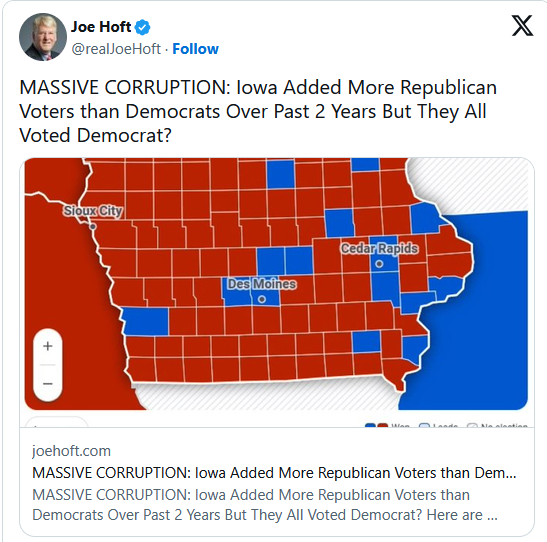

No, they did not all vote Democrat.
Decision Desk HQ reports 688,694 votes for Democrat Josh Turek, 631,461 for Republican Ashley Hinson, and 42,142 for Libertarian Thomas Laehn. Turek’s lead is 57,233 votes, or roughly 4.2 percentage points.
That means hundreds of thousands of Iowans voted for Hinson, while tens of thousands chose neither major-party nominee. The count cannot tell us how each registered Republican, Democrat, or no-party voter cast a secret ballot.
The same results page compares Turek’s margin with President Trump’s 13.26-point Iowa victory in 2024 and calculates a 17.46-point Democratic shift. That is a major political reversal.
It does not tell us that any ballot was altered. The comparison involves two different elections and four different major-party candidates.
Decision Desk HQ projected Turek the winner, but Iowa’s statewide canvass had not yet certified the result when this article was updated on November 18.
Now look at the registration math—all of it.
The Iowa Secretary of State counted 717,165 active Republicans, 541,989 active Democrats, and 582,922 active no-party voters on November 1, 2026. Republicans therefore held an absolute registration advantage of 175,176 over Democrats.
That is a large partisan edge, but it is not a forecast showing how 1.38 million people would vote in a Senate race. No-party voters outnumbered registered Democrats by more than 40,000, and they were free to break heavily toward either candidate.
Republicans represented about 38.64 percent of Iowa’s active registrations, Democrats about 29.20 percent, and no-party voters about 31.41 percent. Those proportions matter because raw growth totals can sound much more dramatic when the entire voter file is expanding.
The state also listed another 13,736 active voters under other affiliations. Any honest account of the electorate has to include them rather than treating Iowa as two locked partisan armies.