
by
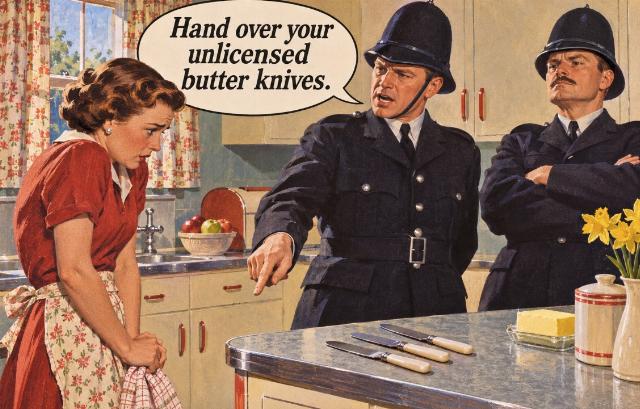
One of the things that sadists and bullies must do to show their control is to humiliate their victims by subjecting them to ridiculous rules.
How does a nation that gave the world Magna Carta, the English Bill of Rights, and the principles of modern parliamentary democracy end up contemplating a licensing scheme for selling butter knives? The answer lies in Britain’s distant and recent past, beginning when Britain was arguably the most powerful nation in the world, and its citizens were justifiably proud of their heritage of individual liberty. What happened in the intervening years offers a cautionary tale for Americans.
By the beginning of the 20th century, Britain was a relatively homogeneous country with a common culture stretching back hundreds of years. Sure, it had suffered invasions (1066), civil wars (1455–1487, 1642–1651), religious tyranny under Puritan rule (1649–1660), and the loss in 1783 of what should have been its empire’s crown jewel (that would be us). But by 1900, it was a robust, thriving nation, so rich, moral, and proud that it was slowly beginning to address the abysmal poverty in its urban areas.
Britain was also, by the standards of its day, a very free country, with people still proud of the “rights of Englishmen” for which the American colonists had fought.
And then the 20th century happened: WWI, which Britain won, but which mowed down 6% of its adult male population (approximately 880,000 men, mostly in the prime of life), people who should have been leaders, innovators, workers, fathers, etc. That was swiftly followed by WWII, which killed off another 384,000 military personnel (again, mostly men in their prime), along with approximately 67,000 civilians.
Oh, and its empire began rapidly disintegrating, with Indian independence in 1947 and the end of the British Mandate for Palestine in 1948.
The surviving nation of angry men and desperate women did what such societies are wont to do: It voted for socialism. And other than the brief Thatcher revolution, it’s been heading down that road ever since.
There’s one more thing Britain did during the 20th century that will play a large role in this story: because of oil, it cuddled up to the oil-rich Muslim Arab nations, many of which were former or soon-to-be former colonies or protectorates.
Along the way, Britain’s march toward increasingly restrictive weapons laws, which had begun before WWII, continued in the postwar era. Gun grabs were an easy sell because, by this time, aside from football yobs and the usual complement of criminals any free(ish) society will have, the British were a relatively low-crime nation.
Between cultural homogeneity, what was the probable effect of a previously harsh criminal justice system removing violent criminals from the gene and cultural pool over generations (see here and here for more information), and a Christian population strongly infused with the principles of the Ten Commandments, the UK was a relatively safe place. And so, willingly, even smugly, to prove that they were better than their violent American cousins, the Brits accepted increasingly restrictive weapons laws.