
Canada Repeals Section 13
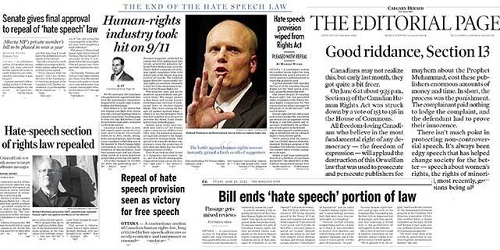
Last week, the Senate of Canada passed Bill C-304, which repealed Section 13 and 54 of the Canadian Human Rights Act. Section 13 was Canada’s shameful censorship legislation, which made it an offence to “likely” “expose” privileged groups to “hatred and/or contempt.” There are NO defences under Section 13! Even truth and intent are considered irrelevant to a finding of discrimination. The law was enacted in 1977 and in the intervening years, not a single person who has been hauled up on Section 13 charges has ever been acquitted – a 100% conviction rate. Section 13 has been used and abused since its inception.
Bill C-304 has a one year implementation period written into it, so in effect, Section 13 will technically be gone in June, 2014. It is unlikely that the Canadian Human Rights Commission will accept and approve any new Section 13 complaints at this point, but who knows, it’s really hard to know what fanatics will do. The CHRC’s main stumbling block is the Canadian Human Rights Tribunal which ruled in the Lemire case, that Section 13 was unconstitutional, and has since stopped all Section 13 cases “Sine Die”. It’s pretty clear the Tribunal does not want to be a willing participant in the Human Rights Commission’s fanatical restriction of freedom of speech, or have any part in the CHRC’s spying and harassing of Canadians. As odd as this may sound, in the judicial system, it was actually the Canadian Human Rights Tribunal which sounded the alarm over Section 13 and the CHRC’s apparatchiks’ handling of cases, and their steadfast refusal to mediate any complaints (which flies in the face of any remedial piece of legislation). Section 13 was never meant to punish and persecute people, but the fanatics at the CHRC just couldn’t resist grinding poor and defenseless people into the ground with protracted and expensive litigation.
So what happens now?
At it currently stands, there will most likely never be another new Section 13 case in Canada, but for those currently in the system; it’s a totally different story.
Bloggers can now rest easy; that the “Nazi fetishists” of the CHRC will not be logging into their websites, dressing up as Nazis and spying on them. Message Board owners can breathe a little bit freer now and not have to worry about busy body “hate finder General’s” looking to cash in on the latest “witch”. The chill that Section 13 placed over all internet communications is now gone.
But for those of us who are caught up in the Section 13 ‘torture rack’, it might still be a while until we can throw off the yoke of censorship. The process is still the punishment, and the CHRC is going to take out their anger and revenge on us. As of today, all other Section 13 cases have been stopped pending a decision in my case. But with being the last standing Section 13 victim, the CHRC is going to open up both barrels on me!
Canadian law is quite a confusing thing. There is a big difference between a repeal of a law, and the court finding a law “unconstitutional”. Of course my entire 10 year legal ordeal against the CHRC has been for the latter. To find Section 13 of the Canadian Human Rights Act an unconstitutional abridgement of the Charter of Rights, and of my freedom of expression. I spent some 6+ years fighting for my freedom before the CHRC and the Human Rights Tribunal. On September 2, 2009, the Tribunal acquitted me of the hundreds of “hate speech” charges leveled against me, and also found that Section 13 was unconstitutional. This ruling was appealed by the CHRC to the Federal Court, which partly sided with the CHRC. The court ruled with me, that the fine provisions were unconstitutional (Section 54), but that Section 13 was just fine. That ruling is currently under appeal to the Federal Court of Appeals, with the Canadian Civil Liberties Association and others supporting my position.
Just to give a better explanation between a repeal of a law, and the finding that a law is unconstitutional. (Keep in mind, I am not a lawyer) My impression is that the Parliament can repeal any law. That does not mean that the law was an unjustifiable infringement on any Canadians. But rather, when a law is found to be unconstitutional, it is the court saying that this law was wrong from the start, and is an unjustifiable infringement. The main difference is, when a law is repealed, no future cases can be brought. But if a law is found unconstitutional, then no cases should have EVER been brought. It may open up an option for individuals to sue the government for wrong doing, as well it demonstrates that no person should have even been convicted under the law. In effect, the law is flawed, and the court is correcting this flaw by striking down the law.
Those are big differences, and especially important for those who are currently before the CHRC’s Section 13 Thought Inquisition. When a law is repealed, it applies going forward. But Canadian law is so screwy that anyone who was previously charged, they have to fight under the previously enforced rules. So basically, the law was “constitutional and in force” when the complaint was filed against me in 2003, so that’s the version of the law I am fighting. Move over ‘Alice in Wonderland’ there is a whole new world where the rabbit hole never ends.
So in other words, I am now fighting at the Federal Court of Appeals, on the constitutionality of Section 13, which has now been repealed. WTF! How much crazier can it get? But it’s no laughing matter. I am fighting against a lifetime speech ban, which if I ever violated, could result in me going to jail for up to 5 years. (Several others in the past have been sentenced to up to 1 year in jail for violating a lifetime speech ban, so this is no joke)
The heart of my appeal to the Federal Court of Appeals is that Section 13 is unconstitutional on dozens of grounds. That it is an unjustified limitation to the Charter of Rights and Freedoms, and not saved by Section 1 of the Charter. That’s really the crux of the case – Section 1 of the Charter. And as part of a review of my Section 1 arguments, the Court has to look at the will and wishes of the Parliament of Canada (pressing and substantial need). And this is where the repeal of Section 13 is going to immensely help me. How can anyone say that Section 13 is a minimal impairment to freedom and “pressing and substantial” in Canada, when the Parliament of Canada has spoken so clearly and repealed Section 13.
My case is the last hurrah for the CHRC censors. There won’t be any new cases, so if they want to leave with a bang (and fanatics always seem to!) they are going to pull out all stops to beat me at the Federal Court of Appeals. In their eyes, if Section 13 has not have been found unconstitutional they can blame those evil “Conservatives” for repealing the law (once again refusing to accept any responsibility for the issues surrounding Section 13) The CHRC has already spent hundreds of thousands of tax-payers money to fight against me over the past 10 years. I would not be surprised in the number was actually in the millions. The CHRC are using a high priced lawyer (actually lawyers) from one of downtown Toronto’s expensive law firms. In order to try to manipulate public opinion, the CHRC spent hundreds of thousands with the astronomical priced Hill and Knowlton public relations firm, to do damage control on the Section 13 file. Gee, that was money well spent! After all, it seems like the censors just see the gullible tax-paying sheeple as an endless pit of CA$H, which they can use to harass and silence those “ignorant” Canadians who just don’t get with their “program”. (Pogrom?)