
Don’t underestimate Trudeau
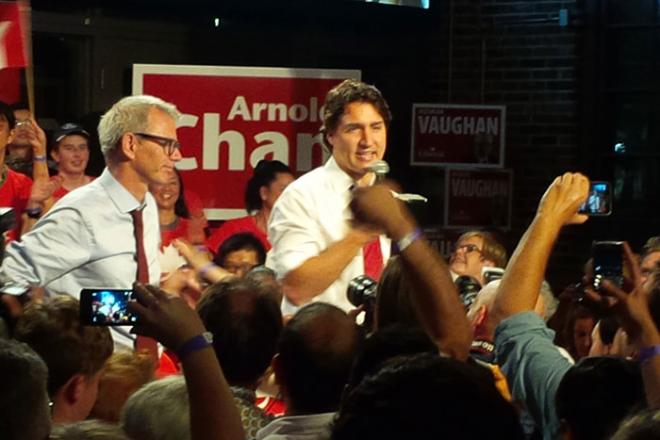
Don’t underestimate Trudeau, say two former Harper advisers
Two former senior advisers to Prime Minister Stephen Harper are warning Conservatives not to underestimate Liberal Leader Justin Trudeau after last week’s four by-election results, saying the Liberals have momentum and could surprise Conservatives in the next election like they did with Liberal leader Jean Chrétien in the 1993 election
“We completely underestimated Mr. Chrétien [in 1993]. My biggest concern is that the Conservatives do not underestimate Mr. Trudeau. Brian Mulroney has said he’s [Mr. Trudeau] the real deal. Whether he is or not, he’s certainly got something that’s appealing [to Canadians],” Bruce Carson, a former senior adviser to Prime Minister Harper (Calgary Southwest, Alta.) from told The Hill Times last week referring to the Liberal Party’s landslide victory in 1993 and where Progressive Conservatives under then-prime minister Kim Campbell were reduced to mere two seats from 169 that they had won in 1988.
In the four byelections that took place on Monday, June 30 between the weekend and the Canada Day holiday, the Liberals won the two GTA ridings and the Conservatives won the two Alberta ridings. But in all four ridings, the Liberals’ popular vote went up.
Keith Beardsley, former deputy chief of staff to Prime Minister Harper told The Hill Times that, in the short term, the Liberals have momentum on their side but it remains to be seen how things will unfold until the next election.
“In the short term, momentum will help him [Mr. Trudeau] in fundraising, in finding candidates, and volunteers for the election machine. Whether he can sustain it and turn that into votes this far out, that’s a different issue. But in the short-term, it’s going to help him,” Mr. Beardsley said, now president of Cenco Public Affairs.
Mr. Beardsley said that the Liberal vote growth in Alberta in byelections means that Conservatives will have to campaign in the next general election in Alberta—the bedrock of Conservative base where, in the past elections, Conservatives won almost all the seats with only nominal campaigns. In the last election, Conservatives won 27 of the 28 ridings.
“They’ve [Conservatives] got to take each riding seriously and that includes Alberta,” Mr. Beardsley said.
The only surprise in the four byelections was the downtown Toronto riding of Trinity-Spadina where Liberal candidate Adam Vaughan, a former journalist and city councillor bested NDP candidate Joe Cressy, a social activist, by a margin of 6,745 or 19.4 per cent of the vote. Former NDP MP Olivia Chow, widow of late Jack Layton had held the riding since 2006 and in the 2011 federal election won it by a whopping margin of more than 20,0000 votes. She resigned her seat in March to run for the mayor’s race in Toronto. Ms. Chow first won this riding from former four-term Liberal MP Tony Ianno in 2006.
Based on the last federal election result in the riding and Liberal infighting which was caused when Mr. Trudeau blocked Christine Innes, wife of Mr. Ianno from seeking the Liberal nomination because of her husband’s alleged bullying and intimidation campaign tactics, the NDP was expected to win the riding. Ms. Innes now is suing Mr. Trudeau and Ontario Liberal campaign co-chair David MacNaughton for $1.5-million for defamation.
The ridings of Toronto-Danforth and Trinity-Spadina held special symbolic significance for the New Democrats as the husband and wife team held both. After Mr. Layton’s death in 2011, the NDP won Toronto-Danforth in March 2012 in a byelection with Craig Scott, a Rhodes scholar and a former law professor at Osgoode Hall law school as their candidate.
Mr. Cressy, 29, a bright social activist and a close family friend of the Layton family played an important role in planning Ms. Chow’s mayoral campaign. Mr. Cressy and Mike Layton, son of Jack Layton were best men at each other’s weddings. In the last NDP leadership campaign, Mr. Cressy, a former senior adviser at the Stephen Lewis Foundation supported NDP MP Paul Dewar’s (Ottawa Centre, Ont.) unsuccessful leadership campaign in 2012. Both of Mr. Cressy’s parents Joanne and Gordon were Toronto City councillors.
Mr. Vaughan, a former CBC and CityTV/CP 24 journalist, whose father Colin was also a Toronto City councillor, is well-known as a popular and good retail politician. He replaced Ms. Chow as city councillor after she resigned to run federally in 2006. In the municipal election, Mr. Vaughan defeated Helen Kennedy, chief of staff to Ms. Chow.
The other GTA riding of Scarborough-Agincourt was expected to stay in the Liberal column as Liberals have held it for more than 25 years. Former Liberal MP Jim Karygiannis had been representing this riding since 1988. He resigned in April to spend more time with his family and to run municipally. In last week’s byelection, Liberal Arnold Chan, a former senior adviser to former Ontario premier Dalton McGuinty won by a margin of about 6,500 votes and won a total of 59.6 per cent of the votes.
Conservatives won both Alberta ridings but the popular Liberal vote percentage went up in both ridings.
In Fort McMurray-Athabasca, which became vacant after former Conservative MP Brian Jean resigned his seat in January, Conservative David Yurdiga won by a margin of 11.4 per cent of the vote. He won 46.7 per cent of the vote and second place Liberal candidate Kyle Harrietha garnered 35.3 per cent of the vote. In the 2011 federal election, Mr. Jean garnered 71 per cent and second place NDP candidate Berend Wilting won 13.2 per cent and third place Liberal Karen Young captured 10.4 per cent.
In Macleod, Conservative John Barlow beat Liberal candidate Dustin Fuller, who placed second, by a margin of 51.7 per cent of the vote. The Liberals placed fourth in the last general election. This riding opened up after the early resignation of former Conservative MP and former Cabinet minister Ted Menzies in November. In the 2011 election, Liberal Nicole Hankel won only 3.6 per cent of the vote in this riding but in the byelecton not only came in second but also increased their vote count by about 14 per cent.
Meanwhile, Mr. Carson who served in the Prime Minister’s Office from 2006-2009 and also worked with Mr. Harper in the OLO after Canadian Alliance and PC Parties merged in 2003, said the attack ads that Conservatives have been running against Mr. Trudeau since he became party leader have not been producing the desired results. He said that his party should come up with more substantive attack ads rather than using “throwaway phrases” like “he’s in over his head.” Mr. Carson said that the Conservatives should pay particular attention to next year’s budget and election platform and make it exciting and innovative in order to ask Canadians for another mandate.
Mr. Carson, however, cautioned that although the Liberals have done well in byelections, it remains to be seen how the Liberal leader will perform in the general election campaign when it lasts 37 days and there will be 338 ridings, televised leaders’ debates, and a lot more scrutiny of him and his party’s record.
“…The appeal that Trudeau has, that’s exciting and they put a lot of attention in the byelections which is easy to do because there are only three or four happening at the same time,” said Mr. Carson.
“What I think Mr. Trudeau and Gerry [Butts] and others have to figure out is how do you take that and translate it into over 300 ridings.”
Since Mr. Trudeau became party leader last year, there have been nine byelections. In all, Liberals not only won their own ridings, but also knocked off the NDP in Trinity-Spadina and the Conservatives in Newfoundland and Labrador, where new Liberal MP Yvonne Jones defeated former Cabinet minister Peter Penashue. In all nine byelections, the Liberals’ popular vote percentages went up.
New Democratic Party spokesman George Soule told The Hill Times that his party is disappointed with last Monday’s byelection results and are now regrouping to plot their strategy for the fall Parliamentary session and the next general election. But he also warned that pundits should not read too much into the NDP defeat in Trinity-Spadina as he said his party has experienced similar setbacks before.
Using the example of 2010 byelection in the Manitoba riding of Winnipeg North, he said that the NDP lost that riding to Liberals after former NDP Judy Wasylycia-Leis stepped down. At the time, he said, pundits declared that the momentum was with the Liberal Party and declared then-Liberal leader Michael Ignatieff as prime minister, but the 2011 general election produced a very different scenario.
“I remember a lot of analysis back then saying, ‘That was a good sign,’ and ‘That Jack Layton was done and that Michael Ignatieff is going to be the prime minister,’ but you saw how it turned out in the [general] election,” said Mr. Soule.
In the last general election, the NDP in an unprecedented move, increased its seat count from 36 to 103, thanks mostly to the unexpected gain of 59 seats in Quebec and for the first time in the party’s history, won official opposition status.
As for NDP’s loss in Trinity-Spadina, Mr. Soule gave all the credit to Mr. Vaughan’s popularity in the riding, but did not comment on whether Mr. Trudeau’s appeal had anything to do with it.
“When you look at Trinity-Spadina, it’s hard to argue that this wasn’t Adam Vaughan’s name recognition, Adam Vaughan’s campaign,” said Mr. Soule.
Deputy Liberal leader Ralph Goodale (Wascana, Sask.) said that last week’s positive byelection results for his party have showed that the momentum is with the Liberals, but that now the onus is on Liberals to ensure that they carry the momentum to the next election.
“There’s a mood for change in the air, but change doesn’t happen by accident or by default,” Mr. Goodale said.
“That’s our job [to carry the momentum forward]. It’s very encouraging to have that sense of momentum but one should never assume it comes automatically. It’s not easily gained and it’s not easily sustained. All Liberals will have to work very hard to keep up the pace. What we can say thus far is, so far so good, but we’ve got a long way to go, a lot of hard work to do, and this campaign for 2015 is really only just beginning.”
In the next election, Mr. Goodale said that his party is trying to find the best candidates from across the country, work on a strong message focused on economy, and come up with an election platform that catches the interest of Canadians.
“He’s [Justin] demonstrating this is not a one man show. This takes a team and it has to be a team drawn legitimately form every corner of the country with the talent not only to represent but also to govern,” said Mr. Goodale.
“Those are the three ingredients that are coming together for Justin—his own leadership, his strong candidates and his strong team and a message about the economy and about middle class Canadians and about fairness and about renewing our democracy that Canadians find timely.”
Meanwhile, the voter turnout in all four ridings was low most likely because the byelections took place between Canada Day holiday and the weekend and any outcome in all four ridings would not have changed the dynamics in the House. In the riding of Fort McMurray-Athabasca, the turnout was at 15.9 per cent—the lowest in any riding in modern Canadian political history. In the riding of Macleod, the turnout was slightly better at 19.6 per cent. In the two GTA ridings, the turnout was better than Alberta ridings but still low—29.4 per cent of voters cast their vote in Scarborough-Agincourt and 31.6 in Trinity-Spadina.
After last week’s byelections, the Conservatives now hold 162 seats, the NDP 98, the Liberals 37, the Bloc Québécois four and the Green Party has two seats. There are four Independent MPs and one vacant seat—Whitby-Oshawa, Ont.—after Jim Flaherty died in April.