
Parties still in three-way tie after federal leaders’ debate: poll
Parties still in three-way tie after federal leaders’ debate: poll
by Sean Silcoff
A new poll suggests that last Thursday’s federal leaders’ debate on the economy had little effect on party standings, with the three main parties still locked in a virtual tie at around 30 per cent each, one month to go until the vote.
However, The Globe and Mail/CTV/Nanos nightly tracking poll also shows the Liberal Party, led by Justin Trudeau, has knocked the NDP off the top perch as the party most Canadians would “consider voting for.”
The Liberals scored 49 per cent on that question, up from 46.1 per cent one month ago, while the New Democratic Party saw its ranking dip to 45.5 per cent from 48.8 per cent. The Conservatives also dipped over the month, to 39 per cent from 40.1 per cent. The shift is “a lead indicator,” said pollster Nik Nanos, adding it shows “the Liberals may be increasing their accessible vote pool. It shows they have potential to grow.”
The Nanos nightly tracking figures are based on a three-day rolling sample composed of 1,200 interviews, with a margin of error of plus or minus 2.8 percentage points, 19 times out of 20.
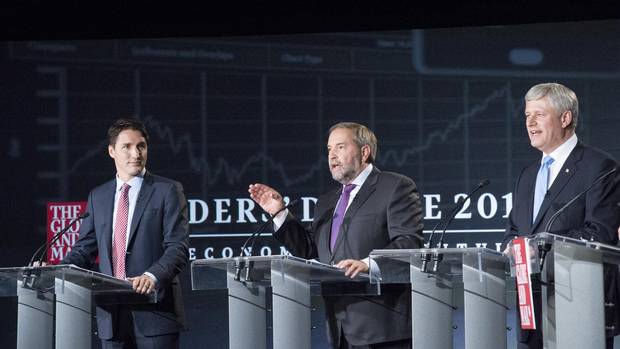
All three party leaders emerged from last week’s debate, hosted by The Globe and Mail, claiming they won as they attempted to outline their vision for the economy at a time when Canada is underperforming other developed economies due to a steep drop in the price of oil and other commodities. But the numbers, even after the debate, show no one was able to differentiate himself as polls have shown the three parties locked in a statistical dead heat for the past 10 days, and closely bunched around the 30-per-cent mark for much of the campaign since it was called in early August.
While Conservative Leader Stephen Harper argues his government guided Canada successfully through the economic crisis and would stay the course, Mr. Trudeau has been promising to run three years of deficits. He says Ottawa needs to go into the red to pay for infrastructure investment and stimulate economic growth, and also proposes to raise taxes for wealthier Canadians while giving the middle class tax breaks. NDP Leader Thomas Mulcair said he takes a balanced approach: Like Mr. Harper, he is pledging to keep balancing budgets, but is proposing to raise corporate taxes to 17 per cent from 15 per cent.
Another finding in the Nanos survey likely to be welcomed by the Liberal party is that it ranks as the most common second choice of voters whose first choice is either Conservative, NDP, Green or Bloc.
Mr. Nanos noted another subtle shift that could play out in Quebec as leaders of parties vying for that province’s seats prepare for the French-language debates: “We’ve seen in the last two or three nights a bit of an uptick in the Bloc Québécois numbers,” he said. “It will be interesting to see with the French debate coming up what the Bloc does to reinvigorate their stalled campaign.”
Support for the Bloc is now at 15 per cent, up from about 10 per cent two days earlier. Thus far in the campaign, however, “it doesn’t seem the Bloc has been a major factor,” said Mr. Nanos, adding that returning party Leader Gilles Duceppe “has to be disappointed” by the overall polling results.
Follow on Twitter: @SeanSilcoff