
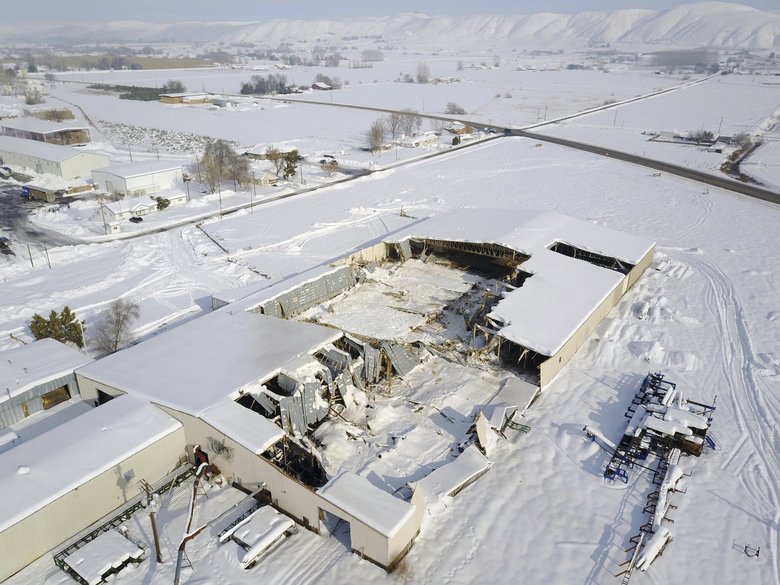
The combination builds up an amount of snow that exceeds building codes set for weather expected only twice a century, said Dell Winegar, president of the Idaho Onion Growers Association, whose industry has felt the pain at its facilities.
Nearly 20 buildings that store and package onions have crashed down in Idaho and Oregon, leading prices to spike from $3.50 to $6.50 for a 50-pound bag of yellow jumbo onions.
“It’s been a heartbreak for a lot of folks,” Winegar said. “It’s hard to prepare for something that has never happened before.”
While lower elevations are getting record snow, mountains in the West are only somewhat above average, forecasters say.
But “that snow hasn’t been melting,” said Troy Lindquist of the National Weather Service. “We’re ending up with snow loads on roofs that we typically don’t see around here.”
Another possible reason behind the collapses is that settling snow does not look as substantial because it’s not as deep, fooling building owners about the weight that’s pressing on shingles and tiles.
“They may look at the roof and say, ‘There’s not as much snow there because it settled,’ ” said Ron Abramovich, a water-supply specialist with the Natural Resource Conservation Service who analyzes the snowpack in mountains. “But it really comes down to the amount of water in the snowpack.”
Abramovich said 20 inches of snow can weigh about 10 pounds per square foot. That means a portion of a 20-by-20 foot roof with that amount of snow would be supporting about 4,000 pounds.
A former factory was bearing much more weight than that when it collapsed this month in the upscale Old Mill District of Bend, Ore.
“Typically, we get a lot of snow, but it usually melts some between snowstorms,” he said, noting that new storms made it too dangerous to remove the snow.
In Alaska’s largest city, the 180,000-square-foot sports center called The Dome, billed as the world’s largest structure supported by pressurized air, collapsed last weekend after a snowstorm dumped more than a foot of snow on Anchorage.
Investigators were trying to determine why the roof’s thin, flexible plastic material, supported by pipes and cables, collapsed.
Higher elevations also have faced problems. In Breckenridge, Colo., a resort mountain town above 9,000 feet, the roof of a hotel conference room caved in last week under the weight of snow. No one was injured, but 70 rooms at the Village of Breckenridge were evacuated.
Worried about more collapses, Idaho Gov. C.L. “Butch” Otter signed an emergency declaration for a county where some 100 buildings have crashed down, including a grocery store in the town of Weiser as well as its popular bowling alley and an antique shop. The state is sending inspectors to examine schools and other structures.
The only injury reported so far is a man whose leg and hip broke when a carport collapsed, said Scott Penner, spokesman for Washington County’s disaster services.