
After frantic night, officials say Lake Oroville may not top emergency spillway
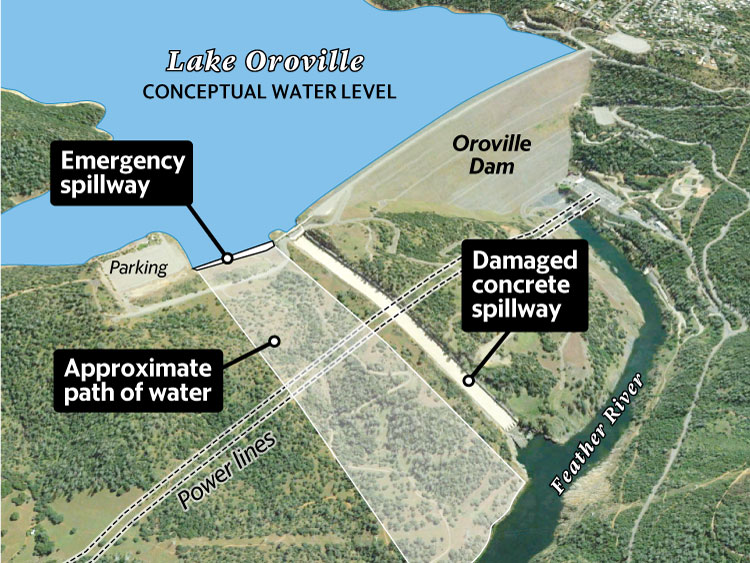
After a grim assessment late Thursday, officials announced Friday morning they think they can avoid using the dam’s emergency spillway, which they’ve been working feverishly to avoid. The emergency structure feeds into an unlined ravine, and the water would propel soil, trees and other debris into the Feather River.
The announcement came after William Croyle, director of the state Department of Water Resources, told reporters Thursday evening that water levels in Lake Oroville could reach the brim sometime Saturday, forcing activation of the emergency spillway. The emergency system, which has never been used, would dump water onto an exposed hillside, dislodging trees and earthen debris into the Feather River and potentially affect communities downstream.
If the emergency spillway has to be used, “you’re going to get a lot of debris and erosion,” Croyle said.
The cavernous fracture in the dam’s main spillway continued to grow Thursday, splitting the massive flood-control structure in two and sending a powerful rush of sediment and debris into the Feather River that threatened the lives of millions of fish at a principal downstream hatchery.
The dam was releasing about 40,000 cubic feet of water per second Thursday afternoon, Croyle said, including about 35,000 cfs from the damaged main spillway. But that was not enough to compensate for the 190,000 cfs pouring into the reservoir from continued storms in the vast Sierra Nevada watershed that feeds the Feather River and its tributaries.
“This storm came in a little warmer, a little wetter,” he said.
DWR spokesman Eric See said late Thursday that engineers had ramped up releases at the main spillway to 42,000 cubic feet of water per second, an increase of about 7,000 cfs. That put total releases, including water pouring out of the dam’s power plant, to nearly 50,000 cfs.
In addition, See said officials were working on a plan to increase releases from the power plant, which has been running below its maximum.
Use of the emergency spillway could be avoided if the rain stops, or officials are able to ramp up water releases from the damaged main spillway to bring down lake levels, he said.
Following two controlled tests, the Department of Water Resources began releasing water at a continuous flow over the main spillway shortly before 11 a.m. Thursday. Water, along with chunks of mud, gushed down the concrete chute, with some of it spilling out of the channel and onto an adjacent hillside.
With engineers unable to release normal outflows through the damaged spillway, water levels behind the dam continued to rise Thursday. The reservoir added about 205,000 acre-feet of water in the 24 hours prior to 2 p.m. Thursday. By the evening, the lake was at 887 feet, or 14 feet below the brim.
Emergency officials said they were preparing evacuation contingency plans in the event conditions continue to deteriorate and create a flood risk downstream. “If we need them to evacuate, we have the mechanism,” said Butte County Sheriff Kory Honea. He urged residents to sign up for alerts at the Sheriff Department’s website or to call 530-538-7826 for updates.
Honea added that he didn’t believe evacuations would become necessary. Threats to human life “are remote at this point,” he said.
Oroville Dam emergency spillway
Water could flow over the never-used spillway on Saturday, potentially dislodging trees and sediment as it rushes down the exposed hillside.

The damaged spillway sits beside the main earthen dam that holds back Lake Oroville, the state’s second largest reservoir and a central piece of California’s government-run water delivery network. The dam can store 3.5 million acre-feet of water, which is divvied out through the year for farming and drinking water needs across great stretches of California. Much of Southern California’s drinking water is stored in the reservoir.
The dam also is a critical piece of the state’s flood-control infrastructure, protecting downstream communities including Oroville, Marysville and Sacramento. The spillway is generally operational only in the rainy season, as a flood-control outlet. Routine water deliveries flow through a power plant at the dam.
DWR officials acknowledged that continued use of the cracked main spillway would cause additional erosion, and might well wipe out the entire bottom half of the structure. As it was, the two test runs held Wednesday roughly doubled the size of the crater that was discovered in the spillway Tuesday, to the point that it severed the concrete, side to side, into two halves.
Kevin Dossey, a DWR engineer, said the department thinks the upper portion of the spillway sits on a layer of solid bedrock. That means officials should be able to continue using the chute without causing serious erosion in the upper reaches, where the spillway gates could be compromised.
“It’s going to continue to chew down,” he said, but “they are very confident it won’t continue to erode to a point of danger.”
As the Feather River below the spillway turned brown with silt, staff with the California Department of Fish and Wildlife raced to transport by truck 4 million baby salmon from a downstream hatchery, fearing they would die in the thick, muddy waters.
“They have turbidity in the river like they’ve never seen before,” said Harry Morse, a spokesman for the department. Turbidity refers to how cloudy the water is. Morse said the hatchery has no method of filtering water as brown as it was Thursday.
Morse said hatchery officials were concerned by the looming possibility of more earth and debris washing into the Feather River should Lake Oroville fill to the point that water would rush uncontrolled over the emergency spillway on the north side of the dam. Work crews from Cal Fire and other agencies were busy chopping down trees in the ravine below the emergency spillway to reduce the amount of debris that would flow into the river if it is triggered.
“Our goal is to get that ravine cleared out,” said Russ Fowler, a Cal Fire battalion chief.
At the fish hatchery just below the dam – one of a handful the state counts on to sustain its $1.4 billion commercial and recreational fishing industries – 4 million salmon were being trucked to holding ponds adjacent to the nearby Thermalito complex, a system of downstream reservoirs. Those ponds would be safe from the cloudy water conditions, Morse said.
That represents just half the baby fish at the hatchery. Morse said the Thermalito facility can’t accommodate all the fish at risk, so more than 4 million will remain in the hatchery while filtration experts try to devise a solution.
Each year the Feather River Hatchery releases 7 million baby salmon into the Central Valley’s waterways. Last March, state officials estimated that fish raised in the Feather River accounted for 63 percent and 76 percent of the state’s recreational and commercial ocean catches, respectively.
“The loss of hatchery-produced salmon from Feather River Hatchery would be a major blow to salmon fishermen in California,” said John McManus, executive director of the Golden Gate Salmon Association.
At the hatchery Thursday, workers waded waist-deep through concrete holding ponds filled with water the color of chocolate milk. They used screens to push baby fish toward tanker trucks that would transport them a few miles southwest to Thermalito.
Fish move
Muddy waters flowing from the damaged Oroville dam spillway forced the removal of millions of baby salmon from a hatchery to nearby holding ponds.

Morse said that wild steelhead and salmon are spawning in the Feather River, fueling concern that sediment could overwhelm their nests and kill eggs and juvenile fish.
While problematic for spawning fish, the sediment and debris shouldn’t significantly raise the prospects of flooding in communities downstream of the dam, said Ben Tustison, an engineer who contracts for the Central Valley Flood Control Association.
“I don’t think there’s enough material to make a significant contribution to sediment downstream (that) would really jeopardize the capacity of the system,” he said.
As of Thursday, state officials said they didn’t know what had caused the spillway breach, nor when they might be able to begin repairs. Eric See, a spokesman for the Department of Water Resources, said fixing the spillway could be months off, given that the top priority is using the chute to keep the reservoir from overtopping.
“We need to keep using the spillway to evacuate water from the lake,” he said. “If the weather changes and dries out, we could potentially do a repair.”
With heavy snowpack in the Northern Sierra, it’s possible the state will have to rely on the damaged spillway well into May, said Joe Countryman, a member of the Central Valley Flood Protection Board and a former engineer with the U.S. Army Corps of Engineers.
Read more here: http://www.sacbee.com/news/state/california/water-and-drought/article131743014.html#storylink=cpy