
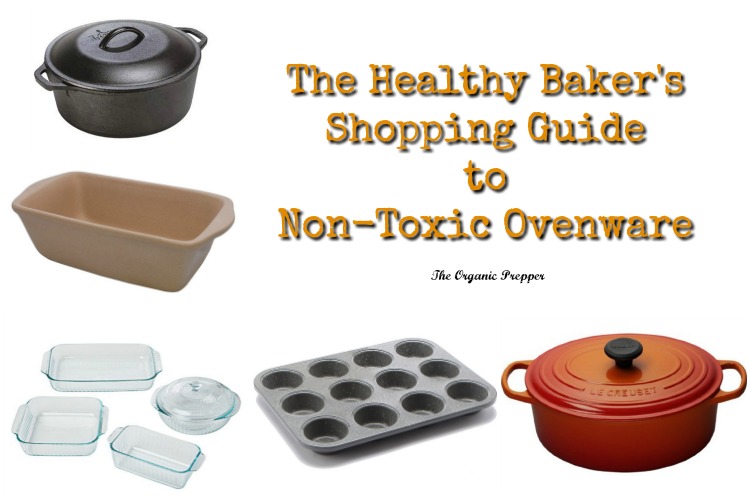
The Healthy Baker’s Shopping Guide to Non-Toxic Ovenware
What could be more wholesome than baking a loaf of homemade bread from organic ingredients, right in your own kitchen? That depends on whether you are baking it in non-toxic ovenware.
Because even when you know every single ingredient in it, sometimes that isn’t enough. Sometimes the vessel in which we are baking our food is undermining our healthy efforts by adding a very unhealthy dose of chemicals to the dishes and desserts that we prepare.
Last week, we talked about cookware and discussed perfluorinated chemicals, aluminum. and many other hazards lurking in our kitchen. (You can learn the details here.) These chemicals can be even more dangerous in the oven due to high temperatures and longer cooking time.
Of particular concern is non-stick bakeware. The per- and polyfluorinated chemicals in the non-stick coating leach into every bite of those muffins, pies, and loaves you’re baking.
That’s what we’ll talk about in this installment of the Whole Home Detox series.
A quick refresher on a few of the toxic substances to avoid
For more detailed information on these substances, check out the article on healthy cookware. Here is a quick refresher:
- Perfluorooctanoic acid (PFOA) has been linked to an increase in liver and pancreatic tumors in lab animals as well as testicular tumors and reduced fertility. PFOA is a chemical used in the manufacture of Teflon and is thought to be one of the biggest dangers associated with non-stick cookware.
- Per- and Polyfluoroalkyl Substances (PFASs) were commonly used in the manufacture of non-stick Teflon pans and bakeware such as pie and muffin tins, and as far back as 2006 the Environmental Protection Agency discussed banning such chemicals, with a total phasing out of them by 2015.If the bakeware you have at home is pre-2015 there’s a pretty good chance that they contain some of these health-harming chemicals.
- Aluminum has been connected with encephalopathy (brain malfunctions) in patients with excess load. Although the changes in the brains of these individuals are different to the malfunctions within the brain caused by conditions like Alzheimer’s, research is ongoing. Aluminum in excess can also cause a change in the permeability of cells, which can block the movement of nutrients in and out of cells. It has also been linked to a reduction of protein synthesis within the cells. (source)
Other common products
Silicone bakeware comes in a wide variety of shapes sizes and colors and according to the FDA it’s safe – but keep in mind that they said non-stick coated bakeware was safe as well and ended up retracting it years later.
Scientific American reports:
It’s sad to say, but since the use of silicone in cookware is fairly new, there has not been much research into its safety for use with food. Back in 1979 the U.S. Food and Drug Administration (FDA) determined that silicon dioxides—the basic elements in silicone cookware—were generally recognized as safe to use even in food-grade contexts. But the first silicone cookware (silicone spatulas) didn’t start to show up on store shelves until a decade later, and the FDA hasn’t conducted any follow-up studies to determine whether silicone can leach out of cookware and potentially contaminate food. For its part, Canada’s health agency, Health Canada, maintains that food-grade silicone does not react with food or beverages or produce any hazardous fumes, and as such is safe to use up to recommended temperatures.
full story at https://www.theorganicprepper.com/non-toxic-bakeware/