
For United States Rulers—Not Just for the Military Industrial Complex—Being AT War is Far More Important than Winning a War
By John Spritzler
“The war is not meant to be won, it is meant to be continuous…The war is waged by the ruling group against its own subjects and its object is not the victory over either Eurasia or East Asia, but to keep the very structure of society intact.”
George Orwell in Nineteen Eighty-Four.
George Orwell was right. Orwell’s insight applies to the militaristic foreign (and domestic with respect to the American Indians) policy of the United States from its inception. How does war, to use Orwell’s words, “keep the very structure of society intact”?
The answer to this question starts with observing that “the very structure” of the society created in North America by British and other European colonists was, in contrast to American Indian social structure, a structure of class inequality, in which some haves were wealthy and powerful; and these haves dominated and oppressed the much larger number of have-nots to enrich themselves. The have-nots were never happy campers, and resisted their domination and oppression by the haves in many different ways, to be examined below.
One of the most effective means by which the class of haves made (and still makes) the have-nots submit to it is by ensuring the existence of a bogeyman enemy (either finding a handy already-existing one or, if necessary, inventing one) so frightening to the have-nots that the haves, by pretending to protect the have-nots from the bogeyman enemy, can make the have-nots obey them despite the very real grievances the have-nots hold against the haves.
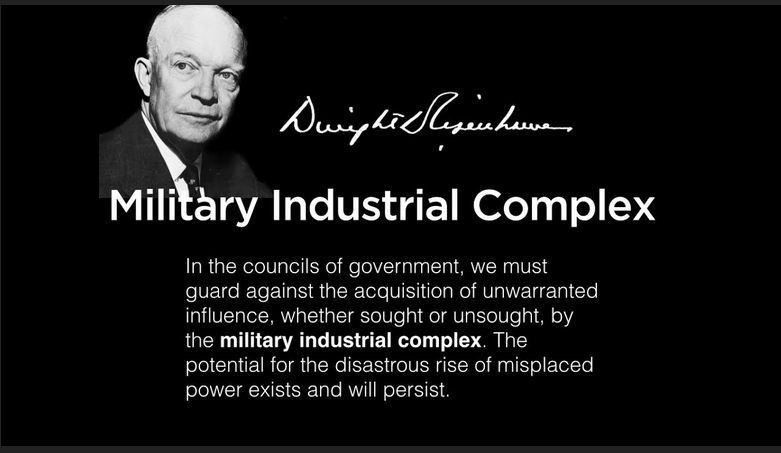
As the title of this article emphasizes, it is the upper ruling class as a whole, not just the part of it that profits from war—the military-industrial complex—that needs to keep the United States at war.
The Americans currently in charge of keeping the United States at war against an enemy are the neo-conservatives—ultra-nationalists promoting a muscular conservatism (breaking from the Republican Party’s historic isolationism during the 1920s).
One of the leading neo-conservative think tanks is the Center for Strategic and International Studies (CSIS). It sponsors each year a “Zbigniew Brzezinski Annual Prize and Lecture.” This website lists CSIS as “One of the top ten think tanks in the world” and says that it “often exerted direct influence on the White House with respect to foreign policy and defense issues.” The website identifies “notable CSIS-associated people” as including former U.S. Secretary of State Madeleine Albright; former Israeli President Ehud Barak; current U.S. Secretary of State Antony Blinken; former U.S. Secretary of State Henry Kissinger; former U.S. Senator Sam Nunn; and Pritzker Organization CEO Thomas J. Pritzker.

Who funds CSIS? Is it only funded by the obvious culprits, the arms manufacturers such as Lockheed Martin and Raytheon? No. It gets funding from a much wider spectrum of Big Money in the United States. According to CSIS’s own website, its corporate funders are listed here, and its foundation funders are listed here (and it also has government funders, of course, listed here).
Some of the corporate funders include Bank of America, Chevron, ExxonMobil, Facebook, JPMorgan Chase, Johnson & Johnson, McAfee, Merck, Microsoft, Oracle, Apple, Canon, General Electric, IBM, Procter & Gamble, Sun Life Financial, United Airlines, Verizon, American Airlines, Disney, Google and Kellogg’s.
Not exactly exclusively arms manufacturers, right?
What about CSIS’s foundation donors? The list includes the Bill and Melinda Gates Foundation, the Robert Wood Johnson Foundation, the Carnegie Corporation of New York, the Rockefeller Brothers Fund and the World Wildlife Fund.
The point is that warmongering against bogeyman enemies is not something that only arms manufacturers want; it is something that the billionaire class in general wants. This ruling billionaire class needs the U.S. to be at war against a bogeyman enemy in order to have any half-way credible argument to persuade the have-not Americans to put up with its obscene wealth, power and privilege and, on top of that, treatment of the have-nots like dirt.

There is actually even a downside to winning a war: It means one no longer has the frightening bogeyman enemy to use to control one’s own have-nots. When Mikhail Gorbachev ended the Soviet Union, he told American diplomats, “I will do something very terrible to you America—I am going to take away your enemy.” [Source: here and an equivalent one here]
Unless you understand the need that oppressive ruling classes have for a bogeyman enemy, you would not understand Gorbachev’s remark. George Orwell, however, understood this point perfectly, which is why he wrote:
“The war is not meant to be won, it is meant to be continuous…The war is waged by the ruling group against its own subjects and its object is not the victory over either Eurasia or East Asia, but to keep the very structure of society intact.” —George Orwell in Nineteen Eighty-Four.

A BRIEF HISTORY OF THE U.S. RULING CLASS USING BOGEYMAN ENEMIES TO CONTROL ITS HAVE-NOTS
Waging War Against the American Indian Bogeyman
When Europeans arrived on the shores of the North American continent, they arrived as a class society, with a few rich and powerful European haves (the ruling class) oppressing the great many European have-nots on the new American land. This point is hardly ever mentioned in the standard discourse, which speaks only of “the Europeans” as if there were no fundamental difference between the haves and have-nots. But there was a fundamental difference.
For one example of this factually wrong standard discourse, and my refutation of it, please see my article about the Mayflower Plymouth Colony here.
Likewise, the standard discourse about our Founding Fathers is a complete cover-up of the truth about how they were the haves oppressing the have-nots back then. Read about this here.
As the Europeans began settling in North America, they of course encountered American Indians who lived there. What happened?
One thing that happened is that a substantial number of European have-nots opted to “go native.”
Ward Churchill wrote about this:
“Probably the earliest group of English to have simply melted into a native society were the inhabitants of Raleigh’s ‘lost colony’ of Roanoak in 1590. A century later, there were literally thousands of ‘white Indians’—mostly English and French, but Swedes, Scots, Irish, Dutch and others as well—who, displeased with aspects of their own cultures, had either married into, been adopted by, or petitioned for naturalization as member/citizens of indigenous nations. By then, the phenomenon had become pronounced enough that it had long-since precipitated a crisis among the Puritans of Plymouth Colony and figured in their waging of a war of extermination against the Pequots in 1637.
“The attraction of ‘going native’ remained so strong, and the willingness of indigenous peoples to accept Europeans into their societies so apparent, that it prevailed even among those captured in Indian/white warfare. During the 1770s, George Croghan and Guy Johnson, both acknowledged authorities on the native peoples of the mid-Atlantic region, estimated that the great bulk of the several hundred English prisoners of all ages and both genders taken by the Indians had been adopted by them rather than being put to death.
“The literature of the period is literally filled with observations. Virginia’s Lieutenant Governor Francis Fauquier, for example, noted that whites ‘recovered’ from Indians had to be ‘closely watched [lest] they will certainly return to the Barbarians.’ Colonel Henry Bouquet, who headed a 1764 expedition to take charge of ‘captives’ returned under terms of a treaty with England by the Shawnees, Miamis and other peoples of the Ohio River Valley, issued orders that ‘they are to be closely watched and well Secured [as] most of them, particularly those who have been a long time among the Indians, will take the first Opportunity to run away.’ The Reverend William Smith, chaplain and chronicler of Bouquet’s foray, noted that most younger whites seemed to view their ‘liberators’ as captors and ‘parted from the savages with tears.’”[1]
One particularly good book about this is the exceedingly well-researched and well-written book, The Unredeemed Captive: A Family Story from Early America, by John Demos. This book describes how, in 1704, Mohawks and French forces captured some English Puritans from Deerfield, Massachusetts.
Over the years following this there were negotiations leading to the return of most of the prisoners. But Eunice, the daughter of a Puritan minister who had been captured and later released, refused to return, married a Mohawk man and made several trips from her Mohawk home in Canada to visit her Puritan relatives for weeks at at time inDeerfield. But Eunice always returned to her Mohawk society despite the strong efforts of her father to persuade her to stay. Read here about another similar story.
European colonist rulers, in contrast, viewed American Indians as sub-human (regarding their rights if not their intelligence), and they waged an ethnic-cleansing war against them. This war at times entailed the goal of physically exterminating (killing) the Indians and at other times the goal of destroying their civilizations, either by destroying their farming civilizations or by destroying their nomadic civilizations based on hunting buffalo, and enclosing them in tiny reservations where they would no longer be an obstacle to European domination of North America “from sea to shining sea.”
A good book about the latter goal of ethnic cleansing, focused on the Great Plains Comanche Indians is Empire of the Summer Moon by S.C. Gwynne. The book tells the story of one of the Comanche great chiefs, Quanah Parker, the son of Cynthia Ann Parker who was a European captured by the Comanches as a nine-year-old girl assimilated into the tribe (who, when “rescued,” kept trying to return to the Comanches).
It is important to know that the particular European colonists who initiated the ethnic cleansing of American Indians, who created the famous “Manifest Destiny” notion that exclusively European domination of North America from “sea to shining sea” was God’s will, and who encouraged and when necessary ordered European have-nots to carry out the violent ethnic cleansing, were also the oppressors of ordinary European colonists and, of course, Black people; they were the slave-owners whom most Southern whites at the time of the Civil War (the period when the ethnic cleansing of the Great Plains Indians was in full swing) hated (yes, hated!) as a class that oppressed them as well as the slaves, as one can read about in detail here.
European ethnic-cleansing violence naturally elicited, in return, Indian violence against European settlers encroaching on their land. The violence on both sides was absolutely brutal: killing and raping and torturing and scalping and so on. It was violence designed to make the enemy leave.
Naturally, when European have-nots were attacked by Indians they tended to rally around their rulers in defense against the Indians. The European rulers gained the obedience of the European have-nots this way. For the European rulers, the Indians made a perfect bogeyman enemy with which to control the European have-nots. Because of this usefulness of the Indians as a bogeymen enemy, the European rulers had a strong motive not to allow peace to break out between Europeans and Indians because that would have rendered the bogeyman enemy no longer frightening enough to drive the European have-nots into obedience to their European rulers.
This is why the European rulers avoided creating peaceful and mutually respectful relations with the American Indians. It did not suit their oppressive (oppressive of the European have-nots, that is) purpose to do so. European rulers were an upper class that valued personal self-interest—greed—and that created a religion to justify not only oppressing European have-nots and African Blacks but also stealing land and wealth from American Indians and killing them to get it.
If the have-nots had succeeded in removing the haves from power, they, along with the American Indians, would most likely have made North America something entirely different from the United States of America that it is today, something with a social structure very different from the class inequality structure that the haves kept intact by waging a war against a bogeyman enemy.
The haves of North America have been using bogeyman enemies to preserve the structure of society by being at war ever since. This is their #1 priority: more important than winning the war is being at war. If peace breaks out, the haves know they are at high risk of losing control over their have-nots and being removed from power. If this ever happened, they would no longer be able to enjoy whatever material gains they might have hoped to gain by winning a war. Thus, it is better for the haves to be at war and not win it than to win a war and let peace break out.