
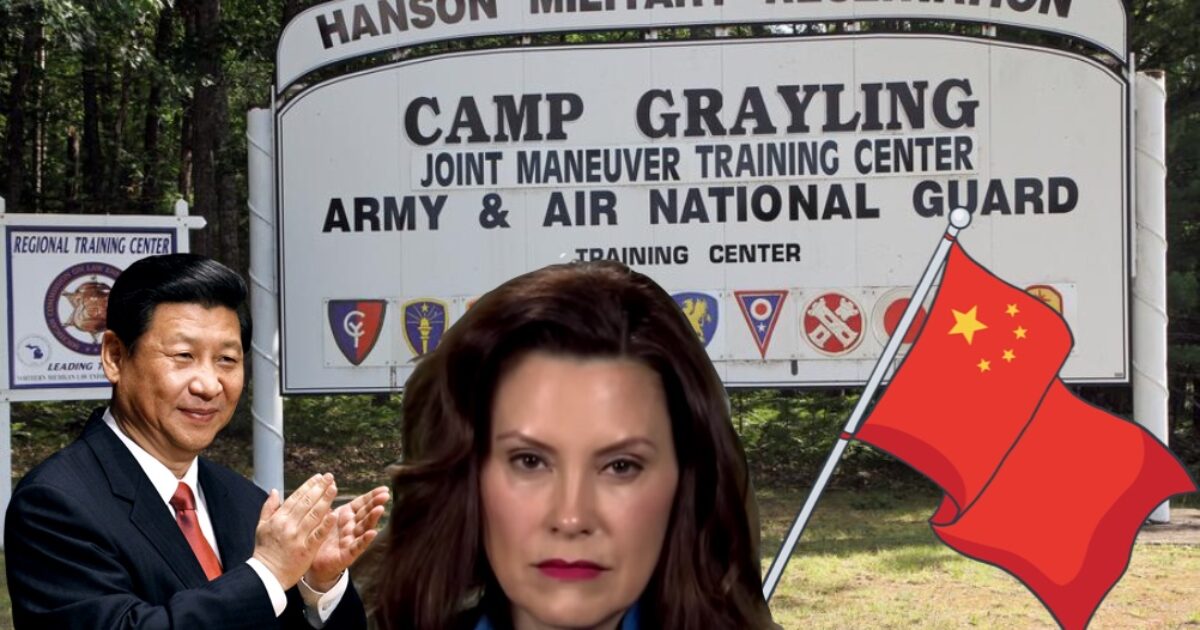
FIVE CHINESE U of M Grads Caught Spying On America’s Largest National Guard Base In MI
Only Short Distance From Controversial Proposed Chinese Battery Plant Supported By Dem Gov. Gretchen Whitmer
Five recent Chinese graduates of the University of Michigan have been charged with conspiracy, making false statements to investigators, and destroying records during the federal investigation. They were caught with cameras late at night on the base at Camp Grayling, America’s largest US National Guard training facility in Grayling, MI.
The students claimed to be there to observe a meteor shower. Their presence coincided with military exercises involving Taiwanese forces, which led authorities to believe they were engaged in espionage.
According to M-Live, the five suspects who graduated from the University of Michigan in May 2024 are Zhekai Xu, Renxiang Guan, Haoming Zhu, Yi Liang, and Jingzhe Tao. They were found on the US military training base in 2023 near tents, military vehicles, and sensitive communications equipment. Court records show that the students were part of a joint program with Shanghai Jiao Tong University.
MSN reports – The students were found at Bear Lake on the camp’s property after midnight on Aug. 13, 2023. About 7,000 military officials, including some from Taiwan, were participating in live firing exercises, records show.
A U.S. sergeant major found the students taking photos near classified equipment and soldiers sleeping in tents, records show.
One of the students told the sergeant major they were Chinese media members. The sergeant major told them to leave, which they quickly did.
Local police later found the students in a Super 8 motel in Grayling. Further investigation of financial transactions showed they were close associates, and Xu booked the room one week before the Aug. 13 encounter at Bear Lake.
Guan was stopped in mid-December at Detroit Metropolitan Airport before a flight to Shanghai. Customs agents searched his luggage and found evidence in Guan’s external hard drive of two photos of military vehicles at Camp Grayling, records show.
Guan told investigators he did not have interactions with U.S. military, government, or police in northern Michigan, records show.
Investigators found messages on the Chinese messaging app WeChat that showed the group discussing the trip to Camp Grayling. Tao discussed the interaction with the sergeant major, while Liang and Guan discussed deleting photos and messages to avoid agents thinking, “we are colluding,” records show.
The complaint states that the students departed the United States after graduation in May 2024.
It is unknown if the former U of M students are in custody.