
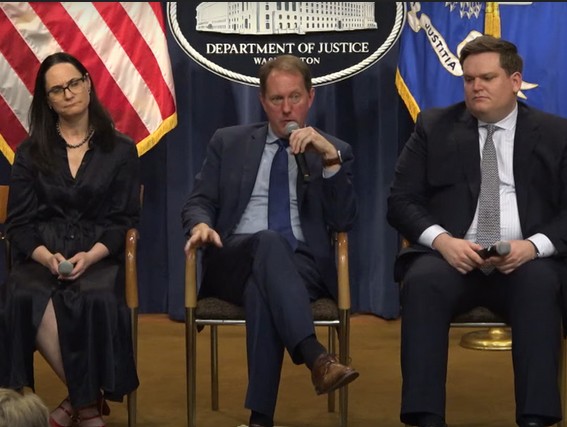
Fired Trump staffer is leading NeverTrumps’ latest lawfare push
By Mehek Cooke
Democrats are trying to turn a straightforward and routine national security decision by Attorney General Pam Bondi into a political scandal.
This time, they are attempting to weaponize an obscure law from the 1970s, the Tunney Act, to undermine her work and score political points.
Their star witness is Roger Alford, a disgruntled former Trump DOJ official fired for insubordination. Today, he poses as a whistleblower, claiming that his former colleagues were corrupt. In reality, Alford is just the latest “Republican defector” willing to trade loyalty for a headline on CNN.
This case is the latest example of Democrats weaponizing rarely used laws against Republicans. But the pattern is always the same: take a vague or unenforced statute and create the illusion of corruption, trigger a media frenzy, and let the narrative do the damage even if the case collapses in court.
As Ayn Rand wrote in Atlas Shrugged, “the only power any government has is the power to crack down on criminals. When there aren’t enough criminals, one makes them.” This is exactly what the Democrats are doing today.
Congress bears the responsibility because, for decades, it has avoided tough legislative work, leaving behind a maze of broad, sloppy statues. By one estimate, the average American unknowingly commits three federal felonies a day. That means that if the government wants to get you, it can. And Democrats — eager to weaponize — know exactly how to exploit those laws.
That’s exactly what we are witnessing with the HPE-Juniper telecommunications merger that Bondi settled and approved this summer.
Intelligence officials concluded that the telecom merger would help counter China’s domination of global networks. A.G. Bondi approved the deal only after ensuring that the settlement protected national security. Alford refused to follow orders, tried to sabotage the deal, and was fired. Now he is touring the press circuit, casting himself as a truth-teller.
Democrat senators immediately followed up on Alford’s “activism” by urging a judge to use the long-dormant Tunney Act, a law designed as a check to ensure that DOJ deals are in the public interest, to derail the settlement. But even Alford admits that the law is “rarely” used this way. His real hope is to launch a fishing expedition in search of supposed corruption — even though there was no wrongdoing.