
Antifa’s Communist Roots, Violent Tactics, and Terror Designation
By Janice Hisle
A presidential order and recent clashes with ICE are drawing attention to the once-obscure, hard-to-define movement.
Law enforcement authorities said last month that they believe the 22-year-old suspect acted alone when he shot Kirk, but are investigating whether anyone else had a role in plotting the killing.
President Donald Trump blamed “the radical left” for inspiring attacks against political figures such as Kirk.
Trump designated Antifa a “domestic terrorist organization” and ordered agencies to root out “any and all illegal operations” connected to Antifa and to prosecute perpetrators and their financiers.
Trump’s executive actions and Antifa’s clashes with Immigration and Customs Enforcement in major cities are drawing more public attention to a once-obscure movement that remains hard to define.
Trump said Antifa has recruited young people to riot, assault police, and obstruct federal agents, while also trying to squelch lawful political speech.
Antifa’s ultimate goal is less obvious and more menacing than that, Trump and others warn.
The president’s Sept. 22 order declared: “Antifa is a militarist, anarchist enterprise that explicitly calls for the overthrow of the United States Government, law enforcement authorities, and our system of law.”
How Antifa Started
Antifascism began as a response to Italian dictator Benito Mussolini in the 1920s. His National Fascist Party was named after a symbol of penal power in ancient Rome, the “fasces,” a bundle of rods with an axe.
In 1932, Antifaschistische Aktion (Antifascist Action), a communist-led militant group that confronted Nazi stormtroopers in Germany, gave the modern Antifa movement its nickname and symbols that are still in use today, such as the raised-fist salute.
The Antifa movement persisted for decades in Europe before spreading to the United States via punk rock culture.
By the 1980s, a group called Anti-Racist Action had risen to prominence in the United States; later, it dissolved into smaller, decentralized groups.
Since the 2000s, Antifa groups have grown globally, largely thanks to the digital age; encrypted messaging networks have enabled Antifa to communicate privately and evade detection.
Although the most prominent Antifa groups in the United States are situated on the West Coast, the earliest groups emerged in the Midwest, including far-left skinheads known as “Baldies” in Minneapolis.
What Is Antifa?
Antifa, in many ways, defies description; journalist Andy Ngo and others told The Epoch Times that’s by design.
“It’s meant to appear as if there is no organization, but they are organized,” said Ngo, author of the 2021 book that became a New York Times best-seller, “Unmasked: Inside Antifa’s Radical Plan to Destroy Democracy.”
Ngo, the son of Vietnamese immigrants who escaped communism, delved into exposing Antifa for years in his hometown of Portland, Oregon. After repeated harassment, threats, and beatings—one severe enough to cause a life-threatening brain bleed—Ngo relocated to outside of the United States.
When FBI Director Christopher Wray and others called Antifa “an ideology” rather than an “organization,” that description was correct but “incomplete,” Ngo said, because what matters is how people organize around that ideology.
“Antifa is the decentralized movement of autonomous networks, groups, cells, and individuals who follow an ideology of violent anarchism and communism,” he said, adding that these people are united in their goal of destroying the United States and all of its institutions.
He said Antifa often commits “violence for the sake of violence,” and may randomly smash a local business as “an attack on capitalism.”
Antifa attracts socialists, communists, and anarchists, but some Antifa adherents may not align with any of those belief systems, according to the report.
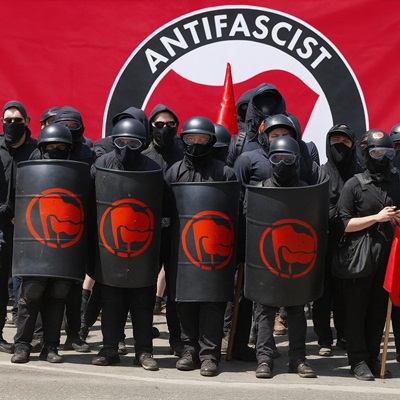
Antifa members often wave black-and-red flags and gather en masse in all-black clothing, known as the “black bloc,” a typical German Antifa tactic to make individual members harder to identify. But even those visual cues don’t reliably identify who is Antifa and who isn’t, the report stated.
Terry Newsome, a Chicago-area parental-rights activist who became the target of Antifa death threats and doxxing after he became vocal about school COVID-19 restrictions in 2020, told The Epoch Times, that “there are tons of ‘Antifa wannabes,’” young people who think it’s cool to associate with Antifa. He’s also convinced that there are a lot of “paid, full-time agitators,” based on seeing the same people show up at numerous protests.
An Insider’s View
Gabriel Nadales, a self-described ex-Antifa participant, wrote in his 2020 book, “Antifa stands for antifascist, but the name is deceptive. … Anyone who dares to criticize the group or its tactics can be labeled a fascist.”
In “Behind the Black Mask: My Time as an Antifa Activist,” Nadales said that many news reports “oversimplify this radical movement.”
Anti-American sentiment is a primary driver of Antifa, he wrote, rather than opposition to fascism.
While he participated in Antifa actions from 2011 to 2012, Nadales said, news outlets mistakenly reported that anarchists orchestrated events that Antifa had actually led.
Rose City Antifa lists numerous stances that it may consider “fascist,” ranging from white supremacy to opposition of labor unions; the group deems a movement “fascist” if it embraces “a majority” of the listed characteristics.