
This Maine School Swapped Detention for Hikes. We Visited to See if It Works.
By Aaron Gifford
Disruptive students put away their phones, walk in the woods, and talk about life for a while.
BATH, Maine—A group of five boys assembles near the main entrance of Morse High School as the dismissal bell sounds and daily afternoon chaos ensues. The boys appear stoic, cloaked in the teenage air of indifference.
Fast-forward two hours and about three miles through ankle-high snow, and the young men, most of them in sneakers, are sprinting across the football field, smiling and throwing snowballs as the sun sets. There is no pouting, slumping shoulders, or complaining about the cold or what they missed at home between 2:15 p.m. and 4:30 p.m.
They had chosen to swap three hours of detention in a warm classroom for a three-mile trail hike on a below-freezing December afternoon.
“I can’t sit still for a long period of time,” said Wyatt McCranie, a sophomore, as the group stepped outside. He faced detention for repeatedly pulling his friend’s low-hanging pants up (not down) during hallway horseplay, disregarding previous warnings from administrators.
The hiking detention at the high school in Bath, Maine, is the brainchild of school guidance counselor Leslie Trundy. Originally from Detroit, she developed an affinity for the outdoors over the years and, after college, hiked the Appalachian Trail of more than 2,000 miles that spans the eastern United States from New England to Georgia.
Trundy said the hiking detentions allow the teenagers to engage positively with nature and with her, allowing them to reflect on what they did wrong and how they can improve while also getting to know peers with whom they otherwise might not associate.
When the teenagers are separated from their smartphones, walking and talking, their behavior appears to become more mature.
“A lot of kids grow up around here but don’t get to know the outdoors,” said Trundy, who has worked in the district for 21 years and began these hikes in October 2024. “It’s an opportunity for them.”
The hikes take place on a trail behind the school every Thursday during the school year. Students who are assigned punishment can select the traditional three hours of detention after school, two hours of volunteer work, or the three-mile hike.
The most common offense is violation of the school phone policy; the devices are off-limits after the first bell and locked in pouches. Skipping class or disrespecting teachers or fellow students is also punishable by detention.
It is too soon to determine whether the hikes have reduced rule-breaking, according to Trundy, but several past participants enjoyed it so much that they joined Trundy’s outdoor club voluntarily.

Parents can veto their child’s decision if they think that traditional suspension is more appropriate, but no one has complained that the hike remains an option.
“One parent said, ‘I’m so grateful for this because I’m afraid my son will earn more detention while he’s in detention,’” Trundy told The Epoch Times.
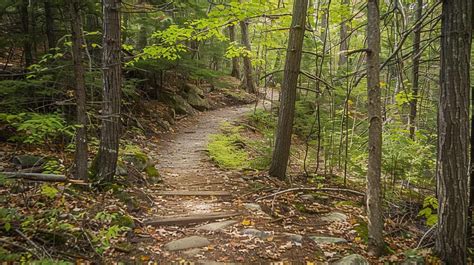
Located 34 miles north of Portland, Maine, at the top of a peninsula, the trail, groomed by volunteers, is not a leisurely walk. It is hilly, windy, and slippery, with narrow footbridges over creeks in a dense New England forest of pine, birch, and fir trees.
Even though the fall colors have long been replaced by a canopy of white, the views are breathtaking.
The group stops at the top of a hill overlooking a pond off the Kennebec River, which connects Moosehead Lake to the nearby Atlantic Ocean.
The boys snack on scooter pies, a Maine delicacy, as Trundy reads a short poem by a Buddhist monk. It speaks of mindful breathing, cultivating compassion, and practicing equanimity.
A moment of silence follows. There are no snickers or sarcastic mutters.
Walking and Talking
A couple of miles in, the hikers revealed more about themselves.
Plummer was there because he skipped study hall. He hopes to avoid detention in the future, he said, but complying with the no phone policy is “gonna be tough for the next year and a half.”
Still, Plummer has always loved being outdoors without the distractions of screens. He played varsity football, but his main interest is firefighting. He has volunteered with a local department for two years now, participating in a live house burn drill and responding to an early morning fatal vehicle accident that happened near the school in September.
When Plummer turns 18, he will get credentials for interior firefighting and can then enter burning structures. Eventually, he wants to become a game warden in the western part of the country and battle wildfires.
“That’s the life I want,” he said. “I get bored really easily sitting around and doing nothing.”
Eli Moody, class of 2029, said that the hike was his first time getting detention but that he had been suspended before “for fighting.” In this instance, he was disciplined for repeatedly disrupting class.
His classmate, fellow freshman Damon Dias, played on a school soccer team this fall, and said his favorite hobby is skateboarding.
Dias received detention for flipping his friend off in the hallway. The “victim,” he said, was a friend who waved her middle finger at him simultaneously.
“But the principal just saw me,” he said.
McCranie, the sophomore who kept pulling his friend’s pants up, loves the outdoors. He talked about the bass, perch, and pickerel he has caught in the pond the group had just visited. He plays baseball and football on the school teams. He and a friend plan to open an auto repair shop in Bath after graduation.
McCranie said his dream car is a classic Dodge Charger with a Hemi engine, but he also imagines building his own hot rod someday—a kit car for which you buy the frame and then select your own parts.
“It’d be one of a kind,” he said.
Malsom Lola, a sophomore, was disciplined for phone infractions. A friend helped him remove the device from the Yondr pouch, but then it fell out of his pocket in front of a teacher.
Lola is still adjusting to the culture of Morse High School, although he loved competing on the football team this year. He moved to Bath after his parents divorced. Lola grew up on the Passamaquoddy Indian Township Reservation, where he is known as “Wolf” in the native language.
Lola makes the four-hour trip home on weekends to visit his father and learn the Passamaquoddy language. He enjoys singing and dancing at tribal events and looks forward to talking about his experiences in social studies class someday.
“There’s not too much I care about, but I do want
The Journey Never Gets Old
At Morse High School, which has about 600 students in grades nine through 12, guidance counselors are assigned to students alphabetically by last name, so Trundy is getting to know many kids for the first time during the hikes.
The blue-collar region has a proud history of shipbuilding, hence the school’s nickname: the shipbuilders. Most of the students have furthered their education in college in recent years, but vocational pathways are making inroads, Trundy said.
Students do not need much more than a nudge to talk about what they might want to become after graduation, she said, and they are willing to listen to suggestions on what they can do to get there.
On a previous hike, one student said she lost interest in school because she thought that it was too late to get into certain electives. Trundy intervened, and the student took the courses she wanted and had a wonderful academic year.

On another hike, Trundy learned that one of the students made good money outside of school trapping lobsters.
A few weeks after that, when conversations stopped, one boy started belting out “I Want It That Way” by the Backstreet Boys, and everyone sang along. Trundy was shocked that all the kids knew the lyrics to a pop song that hit the airwaves in 1999, a decade before they were born.
The physical route of the hike only varies slightly each week based on the season and the weather conditions, but the journey never gets old, according to Trundy.
“I love it,” she said. “You get to learn about them.”