
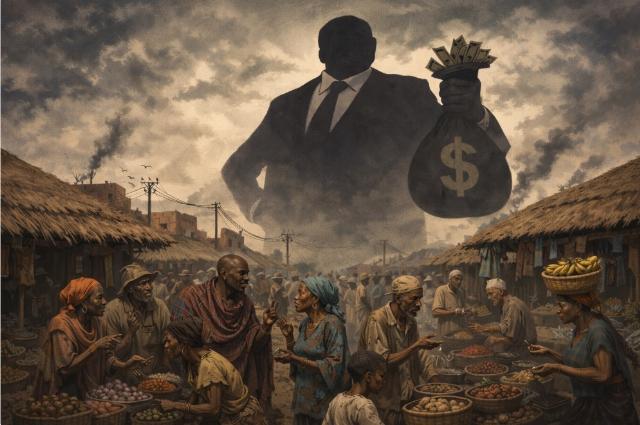
Third World cultures have a corruption problem, and Democrats capitalize on it
By Andrea Widburg
The government fraud scandals in Minnesota and other blue environs reveal an important truth: Not all cultures value honesty and corruption-free government. Until the modern era, American immigrants came from cultures that, at the very least, paid lip service to honesty in both personal dealings and government, and valued long-term wealth creation as an alternative to corruption.
However, immigrants from Africa and the Arab Middle East who have arrived in the United States over the past 30 years come from very different cultures. Their communities, while they may value honesty within their tribe, consider corrupt government the norm and a source of profit for those with initiative. Moreover, having no hope for tomorrow, they seize (in corrupt ways) whatever money they can today.
The English language is replete with sayings about honor and honesty:
- Honesty is the best policy.
- Tell the truth and shame the devil.
- A man’s word is his bond.
- Better to die with honor than live with shame.
- Power corrupts; absolute power corrupts absolutely.
- Truth fears no trial.
In the old days, when Americans testified at trial, they placed their hands on the Bible and swore to “Tell the truth, the whole truth, and nothing but the truth, so help you God.” If they lied, their immortal souls were in peril. (Now, they just make a promise to be truthful and, if they lie, hope an honest prosecutor doesn’t catch up with them…something I saw happen only once in thirty years of litigation work.) The Bible, both Old and New Testaments, demanded truth before God.
While Westerners understood that man is inherently corrupt, they also understood that corruption destroys a nation’s wealth and integrity, and that societies collapse when dishonesty becomes the governing norm. They preached integrity in their houses of worship and policed it in their businesses and government. Our systems were imperfect because humans are imperfect, but we had standards and goals.
It’s different in Africa and the Arab Middle East. Those cultures have “honor,” but it’s a very different kind, one that often seems to be most tightly tied to controlling women’s sexuality. When it comes to dealings with the government and the business world, honor simply doesn’t exist.
I first saw this spelled out when I read Keith Richburg’s superb and still-relevant 1997 book, Out of America: A Black Man Confronts Africa. In it, having served as the Washington Post’s African bureau chief, he explains why he is so grateful that his long-ago ancestors suffered the horrors of the Middle Passage and slavery. Aside from death’s omnipresence in Africa (something you can read about here and here, too), what horrified Richburg was the level of corruption in Africa, which was so extreme that nothing functioned. A joke Richburg tells illustrates how African corruption works (corruption, incidentally, the American government has fed for decades):
So endemic is African corruption—and so much more destructive than its Asian counterpart—that the comparison has even spawned a common joke that goes like this:
An Asian and an African become friends while they are both attending graduate school in the West. Years later, they each rise to become the finance minister of their respective countries. One day, the African ventures to Asia to visit his old friend, and is startled by the Asian’s palatial home, the three Mercedes-Benzes in the circular drive, the swimming pool, the servants.
“My God!” the African exclaims. “We were just poor students before! How on earth can you now afford all this?”
And the Asian takes his African friend to the window and points to a sparkling new elevated highway in the distance. “You see that toll road?” says the Asian, and then he proudly taps himself on the chest. “Ten percent.” And the African nods approvingly.
A few years later, the Asian ventures to Africa, to return the visit to his old friend. He finds the African living in a massive estate sprawling over several acres. There’s a fleet of dozens of Mercedes-Benzes in the driveway, an indoor pool and tennis courts, an army of uniformed chauffeurs and servants. “My God!” says the Asian. “How on earth do you afford all this?”
This time the African takes his Asian friend to the window and points. “You see that highway?” he asks. But the Asian looks and sees nothing, just an open field with a few cows grazing.
“I don’t see any highway,” the Asian says, straining his eyes.
At this, the African smiles, taps himself on the chest, and boasts, “One hundred percent!”
The joke was first told to me by an American diplomat in Nigeria who had also spent time in Indonesia. It carried a poignant message about the debilitating effects of corruption in Africa versus its more benign counterpart in Asia. (pp. 174-175.)