
Maduro Gone, Venezuelans Happy; Russia, China, and the U.N. Powerless to Do Anything About It
On January 3, 2026, U.S. forces carried out Operation Absolute Resolve, a large-scale military strike on Venezuela that resulted in the capture of President Nicolás Maduro and his wife, Cilia Flores. The operation began around 2 a.m. local time with airstrikes on the Fort Tiuna military complex, La Carlota military airport, Miranda Airbase, La Guaira port, and legislative buildings. U.S. special forces then executed a helicopter raid, capturing Maduro at his residence inside Fort Tiuna.
Maduro was transported to the USS Iwo Jima and later flown to New York, arriving Saturday afternoon to face a 2020 narcoterrorism indictment. President Trump stated that the United States would temporarily “run Venezuela” until a “safe, proper and judicious transition” could take place.
The people of Venezuela have suffered under successive socialist regimes, from Hugo Chávez to Nicolás Maduro, from 1999 to the present. Despite vast oil reserves, Venezuela was once twice as wealthy as Chile. Chile adopted free-market principles, while Venezuela chose socialism. Today, Chile is the wealthiest large country in South America, while Venezuela is the poorest.
Most of the Venezuelan population now suffers from food insecurity and lacks access to basic medical care amid severe shortages of food and medicine. The political opposition has been largely silenced through bans on political parties, strict censorship of publishing and communications, and tight restrictions on access to information.
In 2024, the Venezuelan people voted Maduro out of office. He refused to leave. The presidential election was described as “one of the most egregious electoral frauds in modern Latin American history” by political scientist Steven Levitsky. Maduro’s government declared him the winner with 51.95 percent of the vote, but opposition tally sheets collected from 80 to 85 percent of polling stations showed Edmundo González winning with roughly 67 percent to Maduro’s 30 percent. Edison Research exit polls confirmed those results.
The Carter Center stated that the election “did not meet international standards” and that it could not verify or corroborate the outcome. Independent mathematician Terence Tao cited “oddly round percentages,” suggesting manipulation. Venezuela’s National Electoral Council never released precinct-level results, and one CNE rector, Juan Carlos Delpino, went into hiding after stating he had seen no evidence of a Maduro victory.
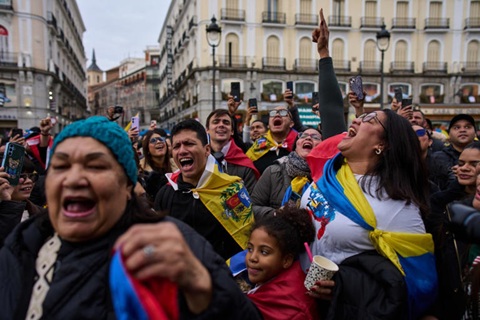
When news of Maduro’s capture broke, celebrations erupted in Venezuelan communities worldwide. In Doral, Florida, crowds filled the streets with Venezuelan flags, chants of “Libertad,” and the singing of both the U.S. and Venezuelan national anthems. Hundreds gathered outside El Arepazo, embracing and expressing hope that the arrest could lead to freedom, the release of political prisoners, and a return to democracy.
Venezuelans spoke of personal losses under Chávez and Maduro, including killings, imprisonment, hunger, and forced exile, and said they longed to return home to help rebuild their country. For many, Maduro’s capture symbolized long-delayed justice after years of repression, economic collapse, and stolen elections. Similar celebrations took place in Spain and Chile. Opposition leader María Corina Machado, a recent Nobel Peace Prize winner, declared, “Venezuelans, the HOUR OF FREEDOM has arrived!” Opposition candidate Edmundo González Urrutia said he was ready for national “reconstruction.”