
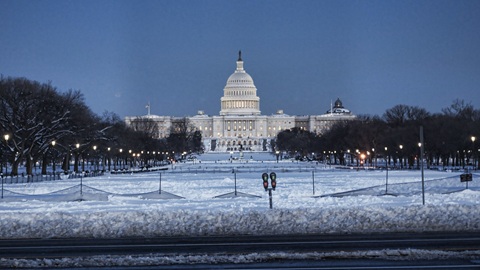
‘Climate Change’ Was Supposed to Make DC Winters ‘More Southern’—And It’s Colder Than It’s Been in Three Decades
by Thomas Catenacci
Temperatures in the district remained below freezing for nine straight days for the first time since 1989
Mainstream media outlets have long reported that climate change would bring “mild-ish” winters to Washington, D.C., that are “more like the South” than the Mid-Atlantic. Then D.C. experienced its longest cold streak in more than three decades.
Temperatures in the district remained below freezing for a nine-day period ending on Feb. 2, 2026, the longest streak since December 1989, according to the Washington Post. That may surprise the Post‘s readers: In February and December of 2020, the outlet reported that “global warming” and “human-caused climate change” were making D.C.’s winters “more Southern.”
“Thanks mostly to a combination of human-caused climate change and urbanization, winters in Washington are warming hastily and taking on an entirely new character,” wrote “climate reporter” Ian Livingston and “climate editor” Andrew Freedman in their December 2020 piece headlined, “Washington winters are rapidly warming up and feeling more Southern.” “Our winter climate is on a southbound journey, with nothing in the way. … The frequency of bitterly cold winter days is in decline.”
Months earlier, Jason Samenow, another writer on the Post’s climate team—which at its height was staffed by more than 30 people—came to a similar conclusion. He penned a piece headlined, “Global warming is making Washington’s climate more Southern. This winter, it most resembles Atlanta’s.”
“Since the winter solstice on Dec. 21, Washington’s weather has taken an excursion toward a far more southern clime,” Samenow wrote. “Because of human-induced climate warming, winters like this—characterized by a lack of extreme cold and spotty snowfall—may become the norm this century.”