
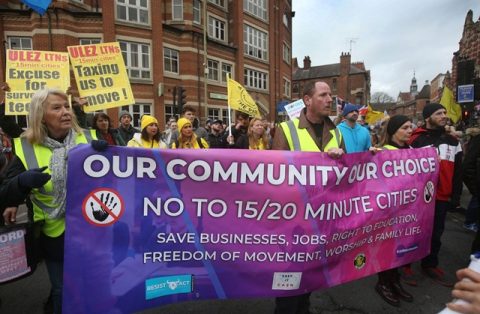
What is a 15-Minute City?
by
The 15-minute city (FMC) is an urban planning concept designed to meet the sustainability targets and indicators pursuant with Sustainable Development Goal 11 (SDG 11). The international construction of 15-minute cities is a global project that is being rolled out in the UK in cities like Oxford and Bath.
The local council’s FMC objective in Bath is to establish a “movement strategy” to engineer “how people move” and “how space is shared.” This will “shift” resident “away from decades of car dependency” and will instead compel them to prioritise “sustainable travel”—walking, cycling and public transport.
The overarching ambition in Bath is to achieve “climate goals.” The local authority is, like nearly every other UK local authority, on an SDG-driven “Journey to Net Zero.” This has led to the creation of four “traffic cells” in Bath. The clearly stated reason for the zoning is to enforce a “reductions in car use.”
Bath’s Journey to Net Zero is being implemented in pursuit of SDG 11.b:
By 2020, substantially increase the number of cities and human settlements adopting and implementing integrated policies and plans towards inclusion, resource efficiency, mitigation and adaptation to climate change.
The UN defines “inclusion” to mean the provision of “equitable access to opportunities and resources.” Therefore, the equitable access to resources—inclusion—in a 15-minute city maximises the “resource efficiency” of residents who must mitigate and adapt to UN climate policies.
The FMC project is Bath and North East Somerset (BANES) council’s contribution to the UN’s centralised and coordinated management of the distribution and allocation of all resources. Otherwise known as sustainable development or, more accurately, Technocracy.
In accordance with SDG 11.2, by 2030 people living in “human settlements” in BANES should have access to “sustainable transport.” By making car use more difficult and expensive, the plan is supposed to achieve SDG 11.6—“reduce the adverse per capita [individual] environmental impact of cities.”
The UK national move towards 15-minute cities is part of “strengthening national and regional development planning” under SDG 11.a. Thus the FMC, in compliance with SDG 11.3, is an attempt to achieve “sustainable human settlement planning and management.”
There is nothing new about urban planning to meet the needs of residents. Garden cities, neighbourhood units, and compact cities are all urban development models aimed at providing easy, or easier, public access to essential goods and services within urban communities.
Planning initiatives like garden cities sought to enhance the draw of urban living—employment, education, health care, etc.—by improving living standards through better access to green spaces, affordable housing and greater opportunities for self sufficiency. The objective was to tackle the rampant squalor and often horrific health consequences of living and working in 19th and early 20th century UK towns and cities, thereby stimulating urban economic growth. For garden city developers, the primary social engineering tools were thoughtful planning and creative design.
The FMCs—variously referenced as complete communities, 20-minute cities and 20-minute neighbourhoods, etc.—utilise an entirely different approach. While the touted FMC offer is to provide residents with access to everything they need within a 15 minute walk or cycle ride from their home—chrono-urbanism—the use of surveillance technology and punitive restrictions to coerce and/or enforce compliance is the preferred social engineering tool.
For example, Oxford has six—rather than Bath’s four—traffic cells or “15-minute neighbourhoods” as local councilors like to call them. ANPR cameras will track Oxford residents who travel by car to ensure they comply with their allocated 100 day car travel allowance. Fines will automatically be levied if they drive outside of permitted times or exceed their 100 day annual limit. Residents living outside the approved zones will need to buy the necessary permits to travel by car, for a maximum 25 days per year, across and between Oxford’s restricted zones.
Ending Oxford residents’ freedom to roam, cutting entry by car for none-zone dwellers, and restricting residents’ movement within their assigned FMC is part of Oxford city council’s commitment to the UN’s global policy agenda. Its latest 2040 Net Zero Action Plan, like Bath’s, splits the city up into Zero Emission Zones (ZEZs) which can be used to control driver’s behaviour by “raising the charges to reflect higher requirements for vehicle efficiency.”
According to Oxford’s “Plan,” The “deployment of active travel infrastructure” such as ANPR surveillance of its citizens’ movements, is designed to lead to a “reduction of motorised traffic.” This will free up “enough road space in Oxford for active travel”—walking, cycling, and public transport. SDG 11.2, in other words.
As highlighted by the Urban Climate Change Research Network (UCCRN)—which operates out of Columbia University and is heavily backed by the United Nations (UN)—the FMC concept was first formalised in 2016 by Franco-Colombian scientist Carlos Moreno. This was also the year that the global Millennium Development Goals were officially transformed into SDGs as part of the UN’s 2030 Agenda for Sustainable Development—Agenda 2030.
UCCRN notes that Moreno emphasised the need to maximise the efficiency of “resource and service provision” including optimising the “number of residents” in an FMC. Moreno argued that FMCs should be established “in all geographies” and that “tailored 15-minute city models” could be built by deploying “advanced technologies such as IoT (Internet of Things), Digital Twins, and 6G networks.”
Moreno’s specialism is smart-city planning and he is the “special Smart-City envoy for the Mayor of Paris.” Moreno was clear from the outset that digital surveillance technology enables FMC developments.
The UN was eager to adopt the FMC model in order to use the technology to impose its SDG policies on urban centres around the world. In 2022, funded by Bloomberg Philanthropies, the global C40 Cities network signed a strategic partnership with the multinational real estate investors NREP to accelerate the global rollout of FMCs. Moreno was also a C40 strategic partner and advisor for the initiative, as was UN-Habitat.
Created in 1977, the role of the United Nations Human Settlements Programme (UN-Habitat) is to establish “socially and environmentally sustainable towns and cities.” UN-Habitat is the UN’s “focal point for all urbanization and human settlement matters.” It works with governments, other intergovernmental agencies, civil society organizations, private philanthropic foundations, academic institutions and the private sector to socially engineer urban populations accordingly.
To this end, UN-Habitat has established the New Urban Agenda as “a framework that contributes to the implementation of the Sustainable Development Goals (SDGs).” The New Urban Agenda decrees that, in order to “contribute effectively to urban sustainability, frontier technologies and innovations need to be applied.”
Just as Moreno advocated, the UN explains what smart-city frontier technology it considers essential for urban sustainable developments like FMCs:
[Frontier technologies] currently include, among others, the Internet of things, sensor networks, machine-to-machine communication, robotics, artificial intelligence, virtual and augmented reality, 3D printing, geographic information systems (GIS), remote sensing, autonomous unmanned vehicles, drones, blockchain, cryptographic computing, and big data processing and visualization.