
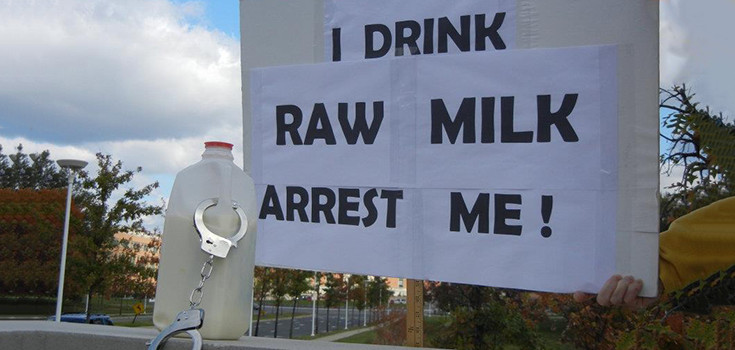
Raw Milk and Food Freedom: Let Farmers Feed Their Neighbors
For most of our history, milk was milk, just as God gave it to us — fresh, local, and purchased directly from the farmer. Not too long ago, milkmen transported milk using horse-drawn carts and followed delivery routes. Only in the last century did government regulators steadily convert ordinary food into a bureaucratic product, insisting that uniform “safety” requires centralized control, industrial processing, and one-size-fits-all rules around the country. The result has been predictable, and is seen in rural America: fewer small producers, higher compliance costs, less consumer choice, more monopolies, and a food system increasingly dominated by politically favored middlemen. In other words, powerful lobbying interests achieved policies that reduce competition, driving up costs for consumers.
Raw milk has become a hot topic in that larger struggle. Across the country, legislatures are beginning to push back — not because lawmakers suddenly discovered nutrition, but because citizens are demanding the freedom to buy and sell food without government acting as a national dietician. When the state treats peaceful commerce as a crime, it denies the first principles of a free people: the right to contract (protected under Article I, Section 10 and the Ninth Amendment of the U.S. Constitution), the right to property (protected by the Fourth, Fifth, Ninth, and 14th Amendments of the U.S. Constitution), and the right to make voluntary choices for one’s own household (also protected by the Fourth, Fifth, Ninth, and 14th Amendments).
While states are creating limited exceptions, the federal government is unconstitutionally asserting the power to prohibit interstate commerce in raw milk for human consumption — an aggressive claim that rests on the incorrect and ever-expanding interpretation of the Commerce Clause and a sprawling regulatory state our Founders would be shocked to see.
The Return of Direct Sales
Several states have taken meaningful steps toward restoring food freedom by legalizing or expanding direct-to-consumer raw-milk sales.
In Hawaii, HB1989 (2024) moved the state toward permitting direct raw-milk sales under defined conditions, including expanded access to certain raw-milk products and limited recognition of goat milk. Though not perfect, the measure reflects an important shift — trusting free people to make informed choices and trusting farmers to serve their communities without treating every transaction as a public-health emergency.
West Virginia’s HB4911 (2024) advanced food freedom by authorizing the sale of raw milk within the state — an explicit rejection of the premise that adults must be shielded from voluntary commerce by regulatory force.
Iowa’s SF315 (2023) established a framework for compliant raw-milk dairies to sell directly to consumers while limiting resale and carving out exemptions from certain layers of state regulation — another recognition that the farmer-consumer relationship does not require an army of inspectors to be legitimate.