
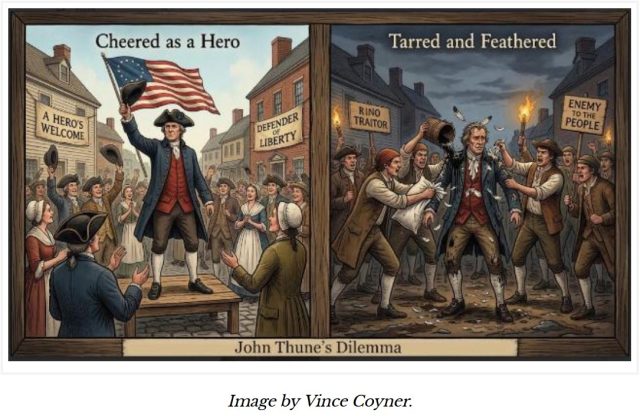
From Benedict Arnold to John Thune: How History Gets Written
by
Thune is at a crossroads: He can be remembered as one of American history’s greatest men or as the second Benedict Arnold.
From 1776 to today, the total number of Americans is estimated to have been around 600 million. That’s about twice what the population is today. One wonders how many historical figures most Americans can name. There are, of course, the obvious ones like George Washington, Abraham Lincoln, Thomas Edison, Henry Ford, and MLK, who are probably at the top of the list for most Americans. They were all known for having done great things.
Most of the rest no one remembers. According to Grok
The average American can likely freely name 10–30 historical figures without much prompting—mostly U.S. presidents, Founding Fathers, major civil rights icons, and a few global names like Einstein, Hitler, or Napoleon—depending on education, age, and interest in history.
Sure, guys like Victor Davis Hanson and Al Franken could probably rattle off thousands, but for the mere mortals among us, a hundred or two probably tops us out.
There is one name, however, that, while it likely doesn’t come up in the first go around for most Americans, is certainly known by a majority: Benedict Arnold.
Arnold was a brilliant general and a true American hero. In fact, the United States might never have succeeded in defeating the British had it not been for him. He was the second in command to the feckless and incompetent General Horatio Gates at Saratoga in September of 1777. At the time, the Americans were on the ropes. They had lost New York, just taken another beating at Brandywine, and were in the process of losing their capital, Philadelphia, for the second time in less than a year.
What’s more, their pleas for assistance across Europe were falling on deaf ears. No one wanted to waste resources on some bedraggled rebels who didn’t have enough munitions, supplies, or experience to take on the most powerful military in the world. Giving them money was a great way to go broke while antagonizing a more powerful enemy. Things were looking very bleak indeed.
This was the background in mid-September, when General Gates wanted to take a cautious approach at Saratoga, despite the British General John Burgoyne’s troops being outnumbered 9,000 to 7,000. Arnold was vociferous about being more aggressive, and eventually Gates relented. The battle ended as a draw, but the patriots had held their ground and survived. Nonetheless, Gates’ and Arnold’s relationship had deteriorated to the point that Gates dismissed him.
Three weeks later, the second of Saratoga’s battles would take place, and Arnold wasn’t about to stand around and do nothing. Without authorization, he rode out into the battlefield, led the men on horseback, and played a pivotal role in the decisive assault that resulted in the British surrender and the capture of 6,000 of Burgoyne’s men, getting gravely wounded along the way.