
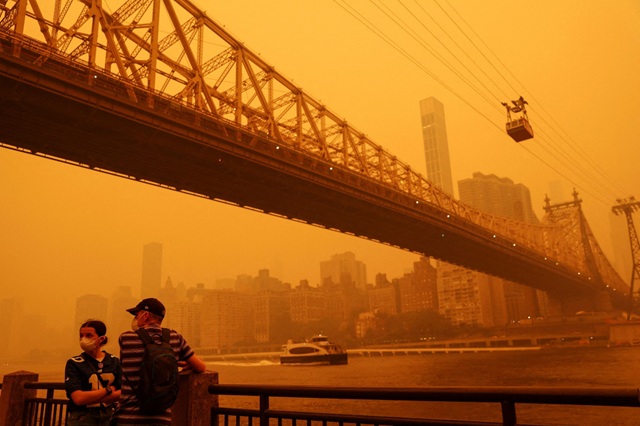
Blame Canada’s Terrible Regulations For Wildfires Ruining America’s Summer
by Joseph Fournier
It’s a perfect storm of the decline of local lumber industries and the policies put in place to (mis)manage Canadian forests.
Americans often picture Canada as a vast northern forest — an endless expanse of pristine wilderness. But the truth is far more complex and increasingly relevant to U.S.–Canada policy debates. Eighty‑nine percent of Canada is Crown land, owned by federal or provincial governments. Yet only about 10–12% of that land receives detailed ecological monitoring.
This matters because U.S. trade policy, Canadian conservation policy, and federal herbicide permitting are now combining to reshape North America’s forests in ways few Americans recognize.
Over the past 20 years, Canada’s sawmill and pulp‑and‑paper sectors have entered a steep decline. Statistics Canada and industry reports show that mill closures have accelerated, especially in western Canada, where over 30% of softwood lumber capacity has disappeared. Employment has dropped sharply. Entire forestry towns have hollowed out.
And while multiple factors contribute — mountain pine beetle damage, wildfire losses, transportation bottlenecks — the most overlooked driver is the federal government’s long‑standing approval of spraying Roundup (glyphosate) herbicide across millions of hectares of Crown forests. For decades, glyphosate has been used to kill broadleaf species — birch, aspen, poplar — so that commercially valuable conifers can dominate.
But this practice has consequences. Roundup creates monoculture conifer stands, which are more resin‑rich and significantly more flammable than mixed‑species forests. Instead of diverse, moisture‑retaining ecosystems, Canada is producing vast tracts of single‑age, single‑species pine and spruce — exactly the kind of forests that burn explosively under extreme fire weather.
The result is a continental paradox: Policies meant to “manage” forests have instead created more combustible landscapes, contributing to the anomalous rise in total annual area burned.
The deterioration of Canada’s forests is also being accelerated by domestic policy. Rising carbon taxes on diesel and gasoline — critical fuels for logging, hauling, and mill operations — have increased costs across the supply chain. New layers of regulation slow approvals and reduce harvest flexibility. And when pulp mills close, sawmills lose buyers for residual chips and sawdust, further undermining their economics.
But the most consequential impact of this industrial contraction is ecological. Canada’s parklands — where monitoring exists — show a clear trend of rapidly aging boreal forests, with large stands now reaching 70 to 120 years old.
In Alberta’s eastern foothills, provincial parks contain dense, overmature, fuel‑loaded forests primed for high‑intensity wildfire. Decades of fire suppression, beetle kill, drought, and heavy recreational pressure have created extreme fire risk. As Parks Canada itself warns, “the reduction or exclusion of fire as a natural process … leads to increased risk of wildfires.”