
 Katy Faust
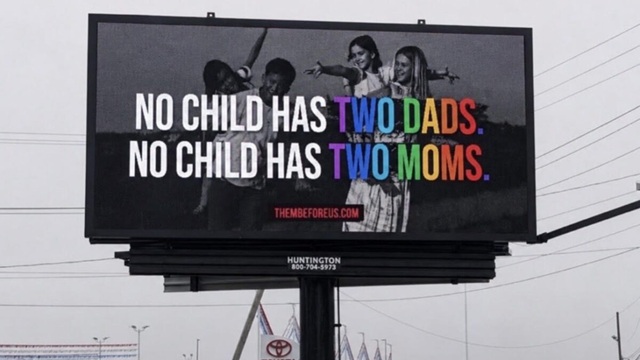
The sign faced immediate backlash and condemnation from local news outlets. Social media influencers denounced it as “anti-LGBTQ rhetoric.” We were accused of hurting children with same-sex parents who might see the billboards on their way to school — or on their way to family court, if their “two moms” had fallen prey to the unusually high lesbian divorce rate.
These accusations get everything backwards. The billboard didn’t create pain for children. It acknowledged it.
The furious reaction to two simple sentences reveals just how much effort has gone into teaching Americans to reject the most basic fact of human existence: every child comes from one mother and one father. That truth is not a Christian doctrine or a conservative slogan. It is a human universal — something every civilization and every religion agreed upon until, historically speaking, about five minutes ago.
Yet suppressing that self-evident reality has required an extraordinary cultural project, waged through law, education, entertainment, and the fertility industry, all in the name of “equality.”
How America Was Taught To Forget Biology
The ink on Obergefell v. Hodges was barely dry before leftist activists moved beyond redefining marriage to redefining parenthood.
In 2017, the Supreme Court’s decision in Pavan v. Smith permitted states to place the spouse of a biological parent on a birth certificate as though he or she were the child’s natural parent. The legal significance extended far beyond paperwork. Birth certificates no longer simply recorded biological reality. They increasingly reflected adult relationships.
That same year, the Uniform Law Commission approved a revised Uniform Parentage Act (UPA), now adopted in whole or in part by more than ten states. The revision systematically replaced “mother” and “father” with sexless terms and expanded legal pathways for unrelated adults to obtain parental status through assisted reproductive technology.
Don’t blame Kathy Hochul for replacing “mother” and “father” with “gestating” and “non-gestating” parents in New York. Blame the Uniform Parentage Act.
This wasn’t merely a change in legal terminology. It represented a fundamental shift away from viewing children as naturally connected to the man and woman who created them and toward viewing parenthood as a legal status the state could assign to any and every adult. Moms and dads were vanishing from law.
But children don’t naturally believe things that contradict what they can plainly observe. They have to be taught.
Schools quickly joined the effort. Before Obergefell, the National Education Association encouraged sensitivity towards different family circumstances while still treating mothers and fathers as the ordinary framework of family life. Mother’s Day and Father’s Day remained uncontroversial fixtures of the classroom.
After Obergefell, the emphasis changed. The NEA’s 2020 checklist encouraged teachers to replace “mom and dad” with terms such as “family” or “caring adult” and to avoid language that assumed children had mothers and fathers. What the courts de-sexed in law, schools increasingly de-sexed in the imagination of children.
Entertainment followed the same script. According to queer activist organization GLAAD, LGBTQ representation on television expanded dramatically after Obergefell. Preschoolers met families with two mothers on Doc McStuffins. Elementary school children watched The Loud House and The Bravest Knight. Teenagers encountered The Fosters, centered on two married mothers raising biological, foster, and adopted children.
The message was remarkably consistent: mothers and fathers are interchangeable. Meanwhile, the fertility industry stood ready to profit from the new demand.
Contrary to early predictions, marriage erasure did not produce a surge of same-sex foster care adoptions. Most same-sex couples, like most heterosexual couples, want children biologically connected to at least one parent. Fertility clinics eagerly supply sperm donation, egg donation, surrogacy, and embryo creation to make that possible.
The adults obtained the biological connection they desired. The child lost the biological parent he or she needed. Biology suddenly mattered very much — until it belonged to the child.
Taken together, these developments reveal a coordinated cultural transformation. Law redefined parenthood. Schools normalized it. Entertainment celebrated it. Reproductive technology monetized it. Our billboard merely interrupted the narrative.