
The Feminization Of America
by
The women’s rights movement moved from Constitutional ideas to an experiment in unintended consequences.
In 1920, with the ratification of the 19th Amendment, America commenced an experiment whose consequences are still unfolding. Women’s suffrage was only the beginning. Over the ensuing century, women steadily expanded their influence in work, education, government, politics, nonprofits, NGOs, and institutions shaping American life. Women now outnumber men on college campuses and have begun to dominate certain institutions.
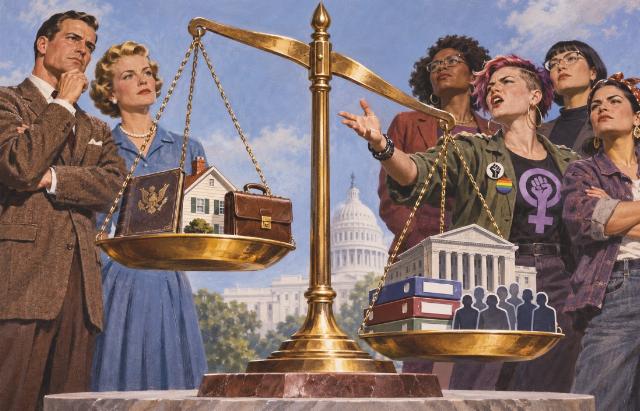
No longer a question of equal rights or opportunities, the more consequential question today is whether the growing influence of women, coupled with the rise of political feminism, has changed not merely who governs America, but the philosophy by which America is governed. Political ideology is increasingly shaping life for everyone, not just activist feminists, leading to a future that not everyone signed up for.
The Founders built a political system around individual liberty, personal responsibility, self-reliance, private property, competition, and limited government. They began with the idea that rights do not come from government; government exists primarily to secure them.
Equality must mean equality before the law and the opportunity to prosper or fail through individual effort—not government-mandated equal outcomes. One philosophy protects the individual’s freedom to succeed or fail; its antithesis treats disparities among groups as evidence that institutions should intervene to ensure particular outcomes. This schism is central to modern political feminism and the power it seeks.
The women’s suffrage movement initially aligned with the Constitution, demanding equal political rights. Second wave feminism emerged in the 1960s, initially seeking to remove barriers to women’s full participation. Again, it was constitutionally aligned. Betty Friedan’s 1963 The Feminine Mystique helped catalyze that movement. Founded in 1966, the National Organization for Women sought to secure equal rights and opportunities for women.
Later, another, more radical theme developed alongside it. Shulamith Firestone’s The Dialectic of Sex (1970), Kate Millett’s Sexual Politics (1970), the Redstockings Manifesto (1969), and Carol Hanisch’s essay “The Personal Is Political” tore into traditional gender roles, hierarchy, and the distribution of power itself: this was radical Marxist-adjacent radicalism masquerading as feminism. The objective was no longer simply equal access to existing institutions, but overturning basic assumptions about human relations, and reorganizing society around a hierarchy of victimhood.
Feminism increasingly became a vehicle for advancing a competing philosophy of social organization—one emphasizing collective responsibility, group identity, and institutional responsibility for correcting perceived inequalities. Many will recognize this as progressivism in practice: obtaining political supremacy through overthrowing existing political dynamics.
Consider how these ideas traveled into institutions. In 1970, San Diego State established the nation’s first Women’s Studies program. Within four years, it became an academic department, and the field quickly spread to universities nationwide.
Ideas developed in these programs moved into professional associations, teacher training, nonprofits, government agencies, and public administration. Graduates and faculty carried theories of patriarchy, systemic inequality, and institutional power into organizations shaping policy. What began as an intellectual challenge to traditional structures increasingly became a kind of incremental societal overwriting.