
REMEMBRANCE DAY
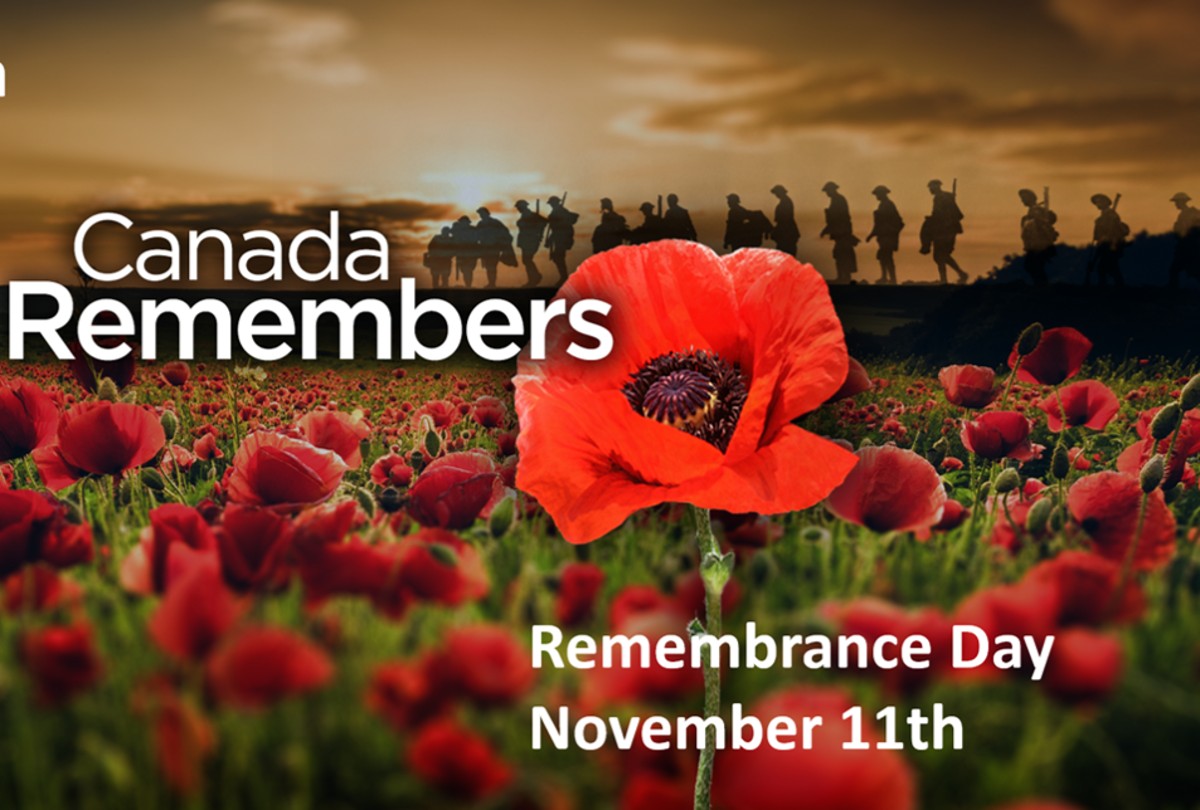
Memorializing Fallen Soldiers
Canadians memorialized fallen soldiers on Decoration Day and Paardeberg Day for many years before Remembrance Day was first observed as Armistice Day in 1919.
Decoration Day
In 1890, veterans of the Battle of Ridgeway (2 June 1866) held a protest at the Canadian Volunteers Monument at Queen’s Park, in Toronto, by laying flowers at the foot of the monument on the 24th anniversary of the battle. The history of the Battle of Ridgeway was muted in Canadian military heritage and history, and the Canadian government had been reluctant to acknowledge the veterans of the battle.
About 850 Canadian soldiers clashed with some 750 to 800 Irish-American Fenians at Ridgeway. Nine Canadians were killed in action and 33 were wounded (see also Fenian Raids).
The veterans’ protest became an annual memorial event known as Decoration Day, when graves and monuments of Canadian soldiers were decorated in flowers. For the next 30 years, Decoration Day was one of Canada’s popular military memorial days, commemorated on the weekend nearest to 2 June. Remembering Canadians who died in the Battle of Ridgeway soon expanded to those killed during the North-West Resistance (1885), the South African War (1899–1902) and the First World War (1914–18).
Paardeberg Day
Before the First World War, Canadians honoured their overseas war dead on Paardeberg Day — 27 February — the annual anniversary of the Battle of Paardeberg in 1900, during the South African War. The battle was Canada’s first foreign military victory.
From 1901 until the outbreak of the First World War in 1914, people gathered in public squares in cities and towns across the country, around newly built South African War memorials, to commemorate their soldiers’ service in South Africa. Paardeberg Day, however, was less a sombre affair of remembrance than a victory celebration and an affirmation of English Canada’s loyal ties to the British Empire.
First World War
The horror and mass slaughter of the First World War (1914–18) changed Canadian perceptions of war. Millions of people were killed at sea and on battlefields across Europe, including 61,000 Canadians. Although Canada fought on the winning side, celebration of victory was replaced by solemn commemoration, and a sense that the country owed a collective national debt to the ordinary soldiers, mostly young men, who had lost their lives in battle.
This debt would be paid, in perpetuity by successive generations, by the simple act of remembering the soldiers’ sacrifice.
Armistice Day
In April 1919, after the First World War ended, Member of Parliament (MP) Isaac Pedlow introduced a motion in the House of Commons to institute an annual “Armistice Day” — to be held not on 11 November, but on the second Monday of November each year.
Parliament was still deciding on a date for the commemoration when King George V sent out an appeal to the British Empire on 6 November 1919. He urged that the armistice that ended the fighting be marked by the suspension of all activities, and the observance of two minutes of silence, at exactly 11 a.m. on 11 November — the same day of the year and time the armistice had been signed in 1918. Canadians commemorated Armistice Day on 11 November in 1919 and 1920.
In May 1921, an Act of Canada’s Parliament declared that an annual Armistice Day would be held on the Monday of the week in which 11 November fell. Oddly, the day was joined with the celebration of Thanksgiving Day, a day featuring sports, turkey dinners and light recreation. This anomaly, which confused the public and angered veterans of the First World War, came to an end on 18 March 1931, when MP A.W. Neil introduced a motion to have Armistice Day observed on 11 November and “on no other date.”
Another MP, C.W. Dickie, moved to change the name from Armistice Day to Remembrance Day. This renaming placed the emphasis more upon the soldiers whose deaths were being remembered. Parliament adopted these resolutions as an amendment to the Armistice Day Act, and Canada held its first Remembrance Day by that name on 11 November 1931. The Holidays Act of 1970 and 1985 recognized it as a national holiday.
In France and Belgium, 11 November is still observed as Armistice Day, while in Britain Remembrance Sunday is the second Sunday in November. In the United States, war veterans are also honoured on 11 November, known as Veterans Day.