
Democrats Criticized the Megaprison That Broke the Gangs’ Hold on El Salvador. Now Latin American Countries Are Building Their Own
Peruvian Justice Minister Ernesto Álvarez announced Nov. 19 that President Keiko Fujimori’s government will build two megaprisons in the Sayán district of Huaura province, north of Lima, with room for about 24,000 inmates. Álvarez said one of the two facilities, a maximum-security prison designed to hold about 10,000 inmates, would be built “with support from the United States.” He said Peru wants to “imitate El Salvador” by putting inmates to work.
Governments in 10 Latin American countries have proposed 16 megaprisons since Salvadoran President Nayib Bukele opened his Terrorism Confinement Center (CECOT) in 2023.
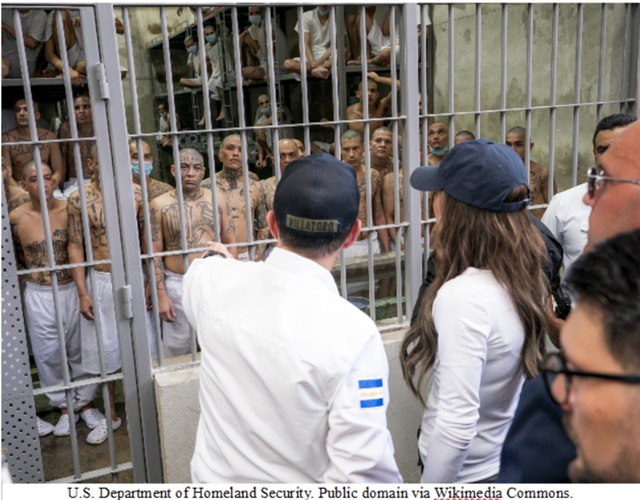
Democrats in Washington attacked Bukele’s prison after the Trump administration deported Venezuelans to El Salvador in March 2025 and Salvadoran authorities incarcerated them there. House Judiciary Committee Democrats called CECOT a “Salvadoran Torture Prison,” and Sen. Tim Kaine (D-Va.) accused Bukele of rounding up tens of thousands of Salvadorans and having “jammed them indefinitely into overpopulated torture centers.” Kaine and Sens. Chris Van Hollen (D-Md.) and Alex Padilla (D-Calif.) introduced a bill to freeze the assets of Bukele and other Salvadoran officials and bar them from entering the United States. The White House praised “President Bukele’s leadership in the region and the example he sets for other nations in the Western Hemisphere.”
Bukele’s crackdown began three years before that fight in Washington. From March 25 to 27, 2022, gangs killed 87 people in El Salvador, including 62 on March 26 alone, according to the National Civil Police. At Bukele’s request, the Legislative Assembly declared a state of exception on March 27, suspending some constitutional guarantees so police and soldiers could arrest suspected gang members.
The government built CECOT in Tecoluca, San Vicente department, to hold people arrested in the crackdown. With room for 40,000 inmates, it is the largest prison in Latin America. By the end of 2025, authorities had arrested 90,844 people under the emergency measure.
El Salvador recorded 6,656 homicides in 2015, a rate of 103 per 100,000 people. Authorities said gangs operated in 90% of the country and collected nearly $2 billion in extortion. Homicides had fallen to 2,383 by 2019. In 2025, the Ministry of Justice and Public Security reported 82 homicides, a rate of 1.3 per 100,000. “For the first time in the history of the country we closed with two digits,” Security Minister Gustavo Villatoro said.
In Gallup’s 2025 survey, 90% of Salvadorans said they felt safe walking alone at night, the same share as in Switzerland and Norway. Across Latin America and the Caribbean, 50% said they felt safe. El Salvador scored 92 out of 100 on Gallup’s Law and Order Index, the region’s highest score. The United States scored 86.
Antonio Ventura, who runs a grocery store in San Salvador, paid gangs $100 a month for nearly 20 years. The demands stopped after the crackdown. “I had to pay up or if not they could make me disappear,” he told the Thomson Reuters Foundation. Aminta Alvarenga, who owns a wholesale store, told AFP in 2024, “We no longer have extortion. The danger has passed.”
Breaking the gangs’ grip on El Salvador has helped businesses grow and drawn more tourists, improving the lives of Salvadorans. The country’s GDP per capita rose from $4,168 in 2019 to $5,767 in 2025 in current U.S. dollars, according to World Bank data. The country received a record 4.12 million international visitors in 2025, and Tourism Minister Morena Valdez said tourism brought in more than $3.6 billion. UN Tourism ranked El Salvador third in the world for growth in tourist arrivals, which were up 92% from 2019.
Costa Rica went furthest in adopting Bukele’s model, building its megaprison from blueprints that El Salvador donated. After the country recorded a historic high of 907 homicides in 2023, President Rodrigo Chaves and Bukele laid the cornerstone for the Centro de Alta Contención contra el Crimen Organizado (High-Containment Center Against Organized Crime), known as CACCO, on Jan. 14, 2026. Laura Fernández, a minister under Chaves, won the February presidential election with 48% of the vote after campaigning on building a megaprison modeled on El Salvador’s.