
Cuba Welcomes Solidarity Brigades — US Marxists Trying to Save the Cuban People from Freedom
A bunch of American liberals, in cooperation with various transnational communist and socialist organizations, set out to “break the U.S. blockade of Cuba.”
They delivered millions to the Cuban regime and never once addressed the fact that citizens have almost no human rights, no protected freedoms, and do not vote in free and fair elections.
The Nuestra América Convoy arrived in Havana on March 21, 2026, and was greeted by Cuban President Miguel Díaz-Canel. The convoy, named after an 1891 essay by Cuban writer José Martí, was organized by Progressive International in coordination with a coalition of aligned groups.
The organizing network consisted of hard-left and anti-capitalist organizations, including the International Association of Democratic Lawyers, which was designated by the CIA during the Cold War as a Soviet-aligned front organization, and Progressive International, whose published materials endorse socialist central planning and express support for communist revolutionary movements.
It was modeled on the Venceremos Brigade, a Cuba solidarity organization co-founded in 1969 by members of Students for a Democratic Society, the Communist Party USA, and the Black Panther Party, and co-created with Cuban government officials. A 1975 U.S. Senate Internal Security Subcommittee report called it “one of the most extensive and dangerous infiltration operations ever undertaken by a foreign power against the United States.”
A 1976 FBI report documented that Cuba’s intelligence agency, the DGI, used it to recruit Americans it hoped would one day obtain positions inside the U.S. government, providing access to political, economic, and military intelligence.
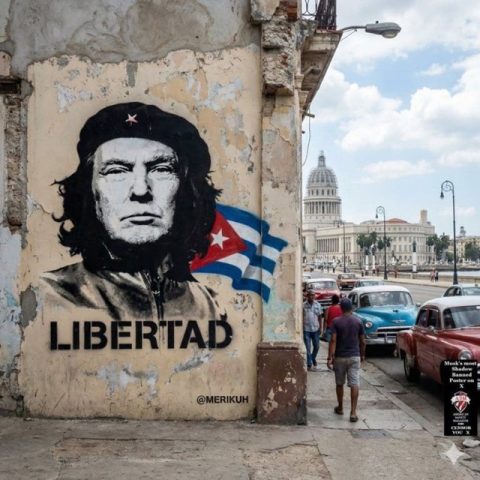
The convoy’s immediate trigger was Executive Order 14380, signed by President Trump on January 29, imposing an oil blockade on Cuba and threatening sanctions against any country that directly or indirectly supplies oil to Cuba.
Prior to 2026, Cuba had received most of its oil from Venezuela and Mexico.
Following the U.S. intervention in Venezuela, that supply was cut off, and Mexico was threatened with tariffs for continuing to ship oil to Cuba.
Cuba produces approximately 40,000 barrels of oil per day but requires roughly 100,000, leaving a gap that subsidized imports from Venezuela, Russia, and Iran had historically filled.
With those supplies gone, Cuba faced blackouts lasting up to 20 hours per day in some areas, along with shortages of food, fuel, and medicine.
However, it is important to note that when Trump initiated an oil blockade, the country was already experiencing prolonged outages, deteriorating infrastructure, runaway inflation, and widespread shortages of food, medicine, fuel, and other basic goods and services.
The convoy delivered an estimated 20 tons of aid, including food, medicine, solar panels, and bicycles, by air from Europe and Latin America and by sea from Mexico.