
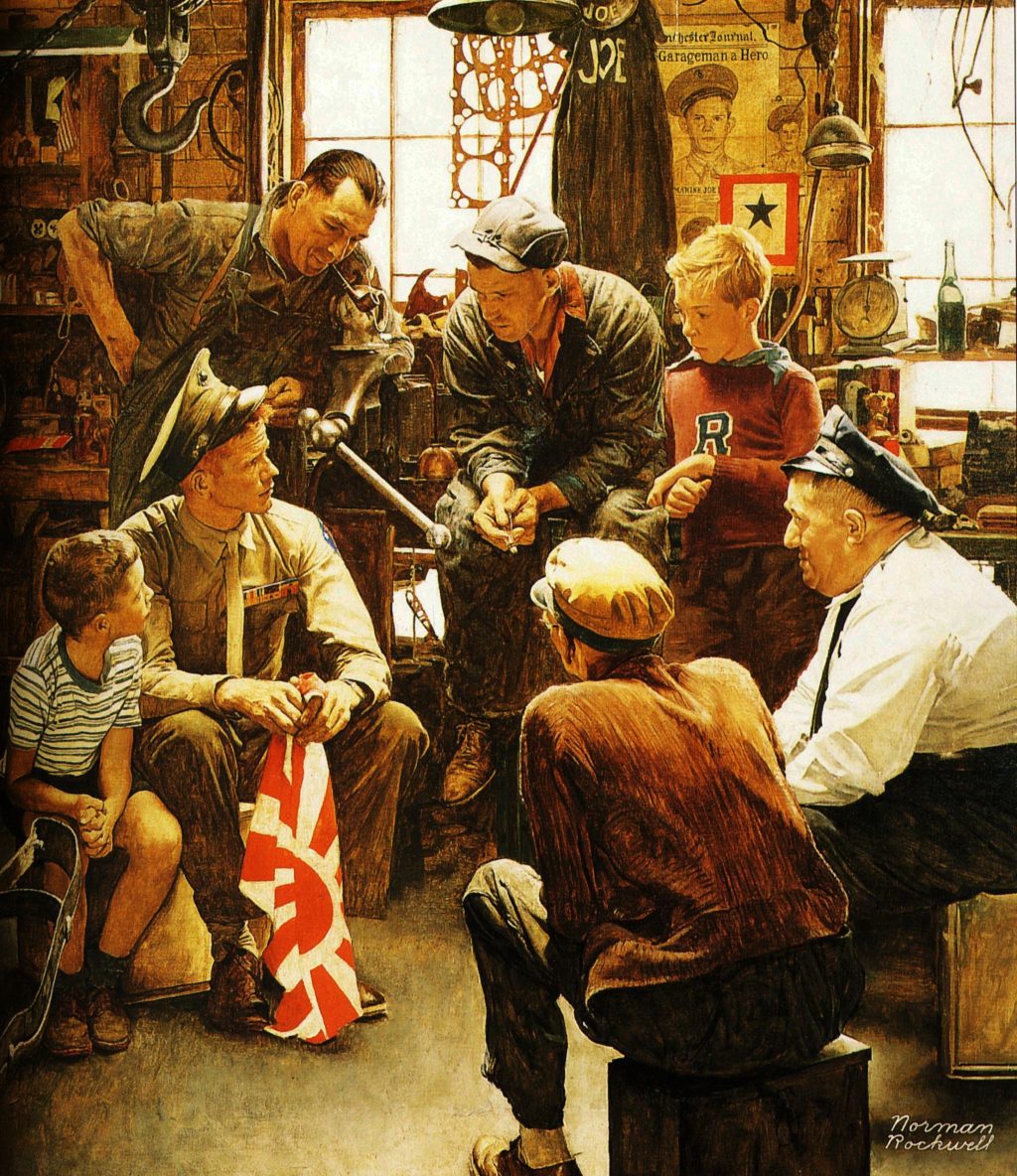
What Made Us American Before The Country Turned Left
by
Those who minimize or dismiss the adverse side effects of America’s “transformation” reveal a failure to regard social and political progress with the seriousness it demands.
My father worked on the docks of New York City when America’s economy was booming before 1929. As with many Europeans of economically depressed countries at the end of World War I, he left his native country to seek a new life in America, which was calling for the extra muscle needed to build a brand new, modern infrastructure . . . from subways and skyscrapers in New York to infinitely more from coast to coast.
Then came the Great Crash of ’29, stopping the great momentum, dramatically illustrated in 1931 when New York’s fantastic new Empire State Building opened its doors in the middle of the Great Depression.
Pop stopped working at the docks and started shining shoes on the streets, while mom was tested to the top of her capacity raising three kids in their dingy Brooklyn tenement. (I was the latest to arrive in the family.) It was a rough ride that made life all the more valuable for overcoming each obstacle, day-to-day and hand-to-hand.
America was in a storm of productivity, early in the 20th Century, with creative advances in every field. Breathless innovations in technology, industry, transportation, communications, and the arts were remaking the landscape and changing American homes almost overnight from primitive to modern.
The daring, the drive, the originality that delivered a vigorous and vibrant America to the world were still in force following the devastation of World War II. Excellence was still taken for granted in industry, education, sports, in the performing arts. In my Brooklyn high school, over 90% of students graduated regularly, having dealt successfully with far tougher standards than today.
Exceptions kept aside, as with any frank discussion, the following observations are intended to depict typical American life before the middle of the 20th century.
Up until about 1960, children that were not orphans had fathers and mothers living together, secure in bonds of love, and rules inspired by the Word of God. That life is sacred was taken as a fact, not an opinion. Women were respected and cherished by men. No high IQ was needed to understand that a man could not be identical to a woman, and no woman could be identical to a man. Respect was common for each other’s actual differences. Men and women would laugh at the notion that male and female are interchangeable, whether in function or psyche. Such an absurd idea, as held by post-Friedan feminists and today’s gender-confused, reveals a mind tangled in abstractions and lost in wish lists — frequent with liberals.
Reality, not science, informed the actions of the typical pre-1960s American, whether living in Manhattan or the boondocks. He and she knew in the bones that scientific knowledge is not wisdom, that opinion and fact are not equal. The alert of every generation knew — and still know — that emotions do not substitute for thinking. Solutions to real problems, not artificial ones from pressure groups, need clear heads anchored in reality.
It was generally understood that freedom comes with a responsibility to use it wisely and accept the results, good or bad, from their source: me. Any needed guidance in difficult matters came from pastors and rabbis, not (as today) from celebrities, think tanks, and